Texting abbreviations can be confusing because the same two letters may mean completely different things depending on the conversation.
If you’ve received a message containing RD, you’re probably wondering what the sender actually meant.
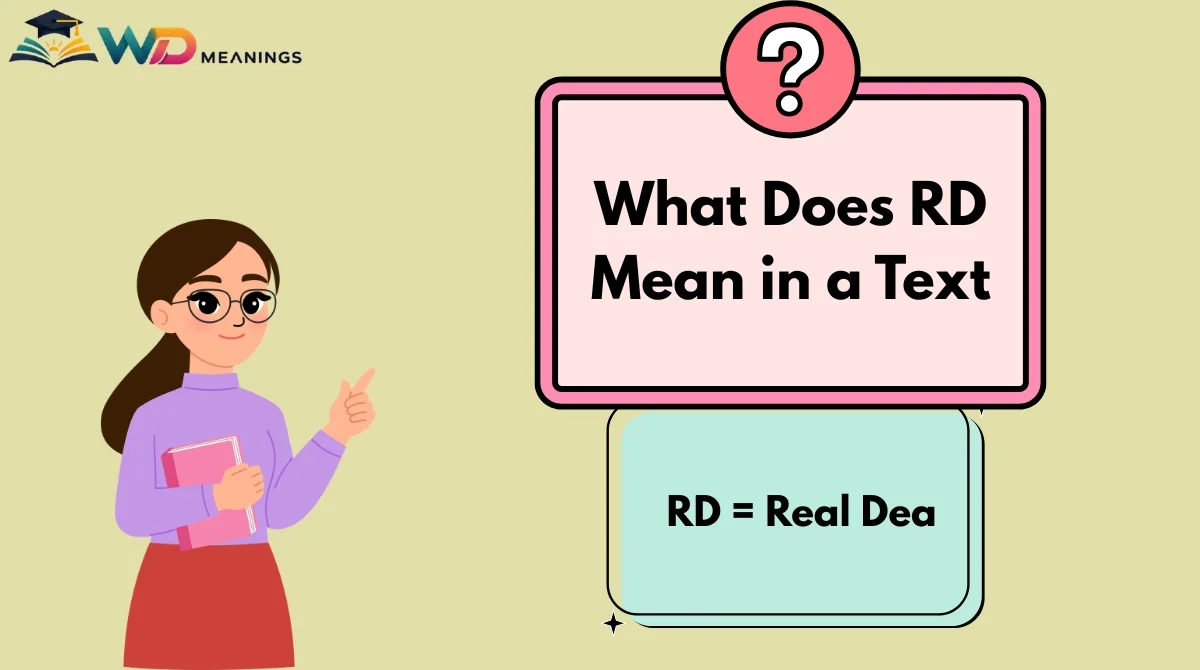
In most text conversations, RD simply means “alright” or “okay.”
It’s an informal shorthand people use to acknowledge a message, agree with someone, or confirm plans.
However, RD can also stand for other things, such as “road” in addresses, “research and development” in work-related chats, or several other context-specific meanings.
This guide explains what RD means in a text, when people use it, how to respond, and how to avoid common misunderstandings.
Quick Answer
RD usually means “alright,” “okay,” or “received” in casual text messages. It’s commonly used as a quick acknowledgment or agreement, similar to saying “OK,” “got it,” or “sounds good.” The exact meaning depends on the conversation, but in everyday texting, it’s typically a friendly confirmation rather than an abbreviation with a fixed official definition.
What Does RD Mean in Text?
In everyday texting, RD is most commonly used as a shortened version of “alright.” Instead of typing the entire word, people simply send “rd” to show they understand, agree, or accept what someone has said.
Unlike abbreviations such as LOL or BRB, RD doesn’t have a universally accepted full form. It’s more of a shortened spelling that developed through fast typing and casual online conversations.
Meaning:
- Alright
- Okay
- Sounds good
- I understand
- Got it
Pronunciation: Most people read it mentally as “alright” rather than saying the letters “R-D.”
Emotional Tone
The tone is usually:
- Friendly
- Neutral
- Casual
- Relaxed
- Brief
Depending on punctuation or emojis, it can sound enthusiastic, indifferent, or slightly dismissive.
Example:
Alex: Can you meet me at 7?
Jordan: RD, see you then!
Here, RD simply means “Alright.”
Origin and Background
The exact origin of RD in texting isn’t clearly documented. It appears to have evolved naturally as people looked for faster ways to type common responses.
Many texting abbreviations developed because early mobile phones had small keyboards and character limits. Even though modern smartphones make typing easier, many users still prefer short replies.
Rather than being an official acronym, RD is generally considered internet shorthand that spread through text messaging, online gaming, social media, and chat apps.
Because it isn’t standardized, not everyone uses RD in the same way. That’s why context is important.
How RD Is Used in Text Conversations
Most people use RD when they want to keep the conversation moving without writing a full sentence.
Agreeing to Plans
Emma: Dinner at 8?
Noah: RD!
Confirming Information
Mia: I emailed the document.
Chris: RD, thanks.
Acknowledging Instructions
Boss: Please finish this by tomorrow.
Employee: RD, I’ll have it done.
Casual Conversations
Friend: I’ll text you later.
You: RD.
Slightly Playful Use
Taylor: Don’t forget you’re buying coffee tomorrow.
Sam: RD 😂
The laughing emoji keeps the tone light and friendly.
When It May Sound Cold
Because it’s so short, RD can sometimes seem uninterested.
Person A: I had a really difficult day.
Person B: RD.
Although the sender may simply mean “I understand,” the reply can feel unsympathetic. In emotional conversations, a fuller response is usually better.
What RD Means on Different Platforms
The meaning of RD generally stays consistent across popular messaging platforms.
People commonly use RD to acknowledge messages or agree with plans.
Example:
“RD, I’ll be there.”
Snapchat
On Snapchat, quick replies are common, so RD often means “okay” or “got it.”
In Instagram DMs, RD is usually a brief confirmation during casual chats.
TikTok
You may occasionally see RD in comments or direct messages, though it’s less common than abbreviations like FR or IMO.
Facebook Messenger
Friends often use RD as a simple acknowledgment without changing its meaning.
Discord
Gamers and online communities frequently prefer short responses. RD often means:
- Alright
- Okay
- Sounds good
Dating Apps
On dating apps, RD typically keeps the same meaning.
Example:
“RD, let’s meet Saturday.”
Relationship context—not the platform—usually determines how warm or enthusiastic it feels.
What Does RD Mean From a Girl or Guy?
The meaning of RD usually does not change based on whether it comes from a girl or a guy.
Instead, focus on:
Conversation Context
If someone is making plans:
RD = Sounds good.
Relationship
A close friend may naturally send one-word replies.
Someone you barely know might appear less engaged if they only reply “RD.”
Punctuation
RD! → More enthusiastic
RD 👍 → Friendly confirmation
RD… → Could sound uncertain or reluctant
Emojis
Emojis often clarify emotion.
RD 😊 → Warm and friendly
RD ❤️ → Affectionate
RD 😂 → Playful
Without emojis, RD simply sounds neutral.
Other Possible Meanings
Although “alright” is the most common meaning in texting, RD has several legitimate meanings in different contexts.
| Meaning | Context | Example |
|---|---|---|
| Alright (most common in texting) | Casual messages | “RD, I’ll call later.” |
| Road | Addresses and navigation | “45 King RD.” |
| Research and Development | Business | “She works in RD.” |
| Registered Dietitian | Healthcare | “Ask an RD for nutrition advice.” |
| Reading | Educational shorthand (less common) | “Finish the RD assignment.” |
Always use the surrounding conversation to determine which meaning fits.
How to Respond to RD
Here are natural ways to continue the conversation after someone replies with RD.
Casual
Them: RD
You: Great, see you later!
Friendly
Them: RD!
You: Awesome! Looking forward to it.
Funny
Them: RD 😂
You: I’ll hold you to that!
Romantic
Them: RD ❤️
You: Can’t wait to see you.
If You’re Unsure
Them: RD
You: Just making sure—did you mean “alright”?
Serious Situation
Them: RD, I’ll handle it.
You: Thanks. Let me know if you need any help.
Planning Together
Them: RD.
You: Perfect. I’ll message you before I leave.
Similar Texting Terms and Differences
| Term | Meaning | Key Difference |
|---|---|---|
| OK | Okay | Standard and widely understood |
| K | Okay | Much shorter and can sometimes sound abrupt |
| Bet | Agreed | Popular slang, especially among younger users |
| Gotcha | I understand | Emphasises understanding rather than agreement |
| Yup | Yes | Direct confirmation instead of general acknowledgment |
These expressions often serve similar purposes, but each carries a slightly different tone.
Common Misunderstandings
Because RD isn’t an official abbreviation with one universal meaning, confusion can happen.
Some common misunderstandings include:
- Assuming it always means Research and Development.
- Mistaking it for road in casual conversations.
- Thinking it has a hidden romantic meaning.
- Believing it always sounds rude because it’s short.
Capitalisation usually doesn’t matter.
- RD
- Rd
- rd
All three often mean the same thing in texting.
The surrounding conversation provides the strongest clue.
Is RD Appropriate or Safe to Use?
Yes. RD is generally a safe, polite, and informal texting abbreviation.
It’s suitable for:
- Friends
- Family
- Classmates
- Casual group chats
- Gaming chats
For professional emails, academic writing, or formal workplace communication, it’s better to write “alright,” “okay,” or “understood.”
RD has no widely recognised offensive, abusive, or inappropriate meaning in ordinary texting. If you encounter a different meaning, it is usually specific to a particular profession, hobby, or conversation.
Examples of RD in Text
- RD, I’ll be there in ten minutes.
- You can borrow my charger.
RD, thanks! - RD 😊 See you after class.
- Movie starts at 7.
RD! - I’ll send the notes tonight.
RD, appreciate it. - RD 😂 You’re always late.
- Can you pick up milk?
RD, no problem. - RD, let’s talk tomorrow instead.
- I’ll call after work.
RD, I’ll wait. - RD 👍 Thanks for letting me know.
- Everyone agreed?
RD from me. - RD. Have a safe trip!
These examples show how RD fits naturally into many everyday conversations.
Frequently Asked Questions
Is RD a real texting abbreviation?
Yes. While it isn’t an official acronym like LOL or BRB, many people use RD as informal shorthand for “alright” or “okay” in casual conversations.
Does RD always mean “alright”?
No. In texting, it most commonly means “alright,” but in other contexts it can refer to “road,” “research and development,” “registered dietitian,” or other meanings. Always consider the surrounding conversation.
Is RD rude?
Not usually. RD is generally neutral and friendly. However, because it’s so brief, it may seem cold or uninterested during emotional conversations where a longer response would feel more supportive.
Can I use RD in professional messages?
It’s better not to. Professional emails and workplace communication are clearer with full words like “okay,” “understood,” or “confirmed.”
Is RD popular among younger people?
Yes. Younger users often prefer short, quick replies when texting, although people of all ages may use RD in informal chats.
What’s the difference between RD and OK?
Both usually express agreement. OK is universally recognised, while RD is informal internet shorthand that some people may not immediately understand.
Conclusion
If you’ve been wondering what does RD mean in a text, the answer is usually simple: it means “alright,” “okay,” or “got it.”
It’s an informal way to acknowledge a message, agree with plans, or confirm that you’ve understood someone.
Although RD has several alternative meanings in specific fields, casual texting almost always points to a friendly confirmation.
Whenever you’re unsure, read the surrounding messages instead of interpreting the abbreviation on its own. Context is the key to understanding what the sender really means.

Hamz Ellis is a content writer at WD Meanings, specializing in internet slang, texting abbreviations, and digital communication. He creates clear, well-researched, and easy-to-understand content to help readers quickly find the meanings of modern online terms.