If you’ve ever received a message that says something like “I’m going w/ my friends” or “Can you help me w/ this?”, you may have wondered what w/ means in text.
The good news is that it’s one of the simplest and most commonly used texting abbreviations.
In most text messages, social media posts, emails, and online chats, w/ is simply a shortened way to write “with.”
It helps people type faster, save space, and keep conversations moving naturally.
Although it’s informal, you’ll see it used across platforms like WhatsApp, Snapchat, Instagram, Discord, Facebook Messenger, and even in quick work messages.
This guide explains exactly what w/ means in text, when to use it, how people use it on different platforms, and how to avoid common misunderstandings.
Quick Answer
W/ is a common abbreviation for “with.” People use it in text messages, chats, social media captions, and online conversations to save time. For example, “I’m going w/ Sarah” simply means “I’m going with Sarah.” It has the same meaning as the full word and doesn’t usually change based on the platform.
What Does W/ Mean in Text?
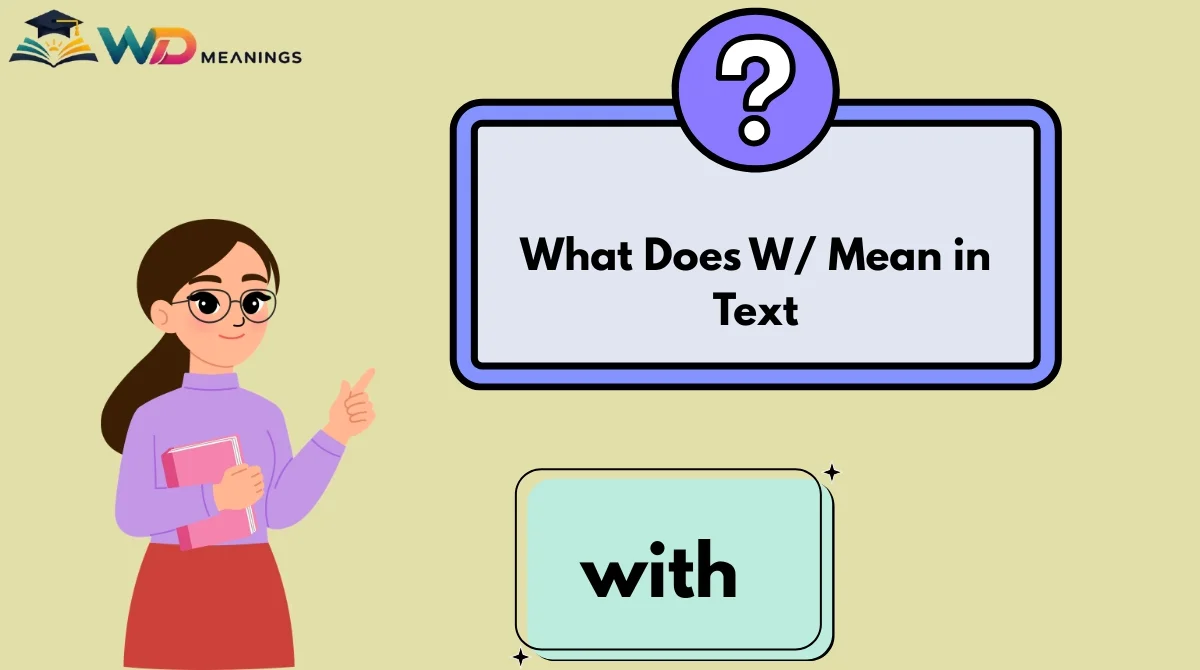
The most common meaning of w/ in texting is “with.”
Instead of typing the entire word, people often shorten it to w/ because it’s quicker and easier, especially on mobile devices.
Full Form
W/ = With
Unlike many internet abbreviations that stand for several words, w/ is simply a shortened written form of a single word.
Simple Definition
W/ means “with” and connects people, objects, ideas, or activities in a sentence.
For example:
- I’m going w/ my family.
- Coffee tastes better w/ cream.
- Can you come w/ us?
Pronunciation
People don’t actually say “double-u slash.”
When reading or speaking aloud, you simply say “with.”
For example:
Text:
I’ll be there w/ Jake.
Spoken:
I’ll be there with Jake.
Tone and Emotional Meaning
The abbreviation itself doesn’t carry any emotional tone.
Instead, the feeling depends on the rest of the message.
For example:
- Excited: “Can’t wait to celebrate w/ you!”
- Casual: “I’m out w/ friends.”
- Romantic: “Dinner w/ you sounds perfect ❤️”
- Professional: “Meeting w/ the team starts at 10.”
The abbreviation doesn’t make a message friendlier, colder, or ruder—it simply saves typing.
Realistic Text Example
Emma: Are you coming tonight?
Noah: Yeah! I’ll be there w/ my brother.
Origin and Background
Unlike internet slang such as “LOL” or “BRB,” w/ wasn’t created specifically for texting.
It’s an old written abbreviation for the word “with.” People have shortened with in notes, handwritten documents, schedules, and forms for many years because it saves space and writing time.
As texting became popular on mobile phones, especially when messages had strict character limits, abbreviations like w/ became even more common. Since it is short, easy to recognize, and rarely confusing, it naturally carried over into digital communication.
Today, you’ll find w/ in text messages, online chats, social media captions, emails, calendars, reminders, and personal notes.
How W/ Is Used in Text Conversations
Because w/ simply replaces “with,” it fits into almost any casual conversation.
Talking About People
People often use w/ when mentioning who they’re spending time with.
Alex: Where are you?
Jordan: I’m shopping w/ my cousin.
Making Plans
It’s common when discussing future activities.
Taylor: Want to grab lunch?
Chris: Sure! I’ll come w/ my roommate.
Asking for Help
The abbreviation also appears in requests.
Jamie: Can you help me w/ this assignment?
Morgan: Of course.
Sharing Experiences
People frequently use it while describing what they’re doing.
I’m watching a movie w/ my family.
Just finished dinner w/ everyone.
Romantic Conversations
The meaning stays exactly the same, although the overall message may sound affectionate.
I’d love to spend the weekend w/ you ❤️
Here, w/ still means “with.” The romantic feeling comes from the sentence—not the abbreviation.
Humorous Conversations
People also use it jokingly.
I’m officially obsessed w/ pizza 😂
Again, w/ simply replaces with.
Negative Conversations
The abbreviation can appear in complaints too.
I’m having problems w/ my laptop.
The abbreviation itself isn’t negative; it’s just replacing the word.
What W/ Means on Different Platforms
The meaning of w/ stays remarkably consistent across almost every messaging platform. The only real differences come from how formal or casual people choose to be.
On WhatsApp, w/ almost always means with.
Examples:
- I’ll be there w/ Mom.
- Can you come w/ me?
Snapchat
Snapchat conversations are usually fast and informal, making w/ especially common.
Examples:
- Hanging out w/ friends.
- Wanna come w/ us?
People often use w/ in captions to keep them short.
Examples:
- Weekend vibes w/ my besties.
- Coffee date w/ my favourite person.
TikTok
TikTok creators frequently use w/ in captions or comments because it’s concise.
Examples:
- Trying this trend w/ my sister.
- Filmed this w/ my friends.
Facebook users may use either with or w/ depending on how casual they want to sound.
Examples:
- Had dinner w/ family tonight.
- Road trip w/ the crew.
Discord
Discord communities often favour quick typing.
Examples:
- Anyone want to queue w/ me?
- I’m playing w/ my team.
Dating Apps
On dating apps, w/ still means with.
Examples:
- Looking for someone to travel w/.
- I’d love to grab coffee w/ you sometime.
There’s no hidden romantic code—it simply replaces the word.
What Does W/ Mean From a Girl or Guy?
Many people wonder whether abbreviations change meaning depending on who sends them. In the case of w/, the answer is almost always no.
Whether a message comes from a girl, a guy, a friend, a coworker, or a family member, w/ still means “with.”
Instead of focusing on the sender’s gender, pay attention to the surrounding message.
For example:
“Want to go w/ me?”
This could be:
- A friend inviting you somewhere.
- A coworker asking you to attend a meeting.
- Someone you’re dating suggesting a date.
The abbreviation doesn’t reveal romantic interest by itself.
Relationship Matters More Than Gender
Consider these examples:
Friend
I’m going w/ everyone after class.
Completely casual.
Partner
I love spending time w/ you ❤️
The affection comes from the sentence and emoji—not from w/.
Coworker
Can you meet w/ the client tomorrow?
Entirely professional.
Punctuation and Emojis Matter
These messages all use w/ but communicate different emotions:
😊 Can’t wait to be w/ you!
❤️ Dinner w/ you sounds perfect.
😂 I’m stuck w/ my little brother again.
😅 Need help w/ this homework.
The abbreviation itself never changes meaning. The surrounding words, punctuation, and emojis tell you how the sender feels.
Other Possible Meanings
Although “with” is by far the most common meaning in text messages, w or W can have different meanings in other contexts. It’s important not to confuse these with w/.
| Meaning | Context | Example |
|---|---|---|
| With (Most Common) | Text messages, chats, social media | “I’m going w/ my friends.” |
| Win (W) | Gaming, sports, internet slang | “That match was a huge W.” |
| West (W) | Maps, directions, navigation | “Drive 5 miles W.” |
| Watt (W) | Science and electricity | “A 60 W light bulb.” |
| Width (W) | Measurements and product dimensions | “Table size: 120 cm (L) × 60 cm (W).” |
Which Meaning Is Most Common in Texting?
When you specifically see w/ with a forward slash in a message, it almost always means “with.”
If you only see the single letter W without the slash, you’ll need to use the conversation’s context to determine whether it means win, west, watt, or something else.
How to Respond to W/ in Text
Since w/ simply means “with,” you usually respond to the overall message rather than the abbreviation itself. Your reply depends on the conversation and the relationship with the sender.
Here are some natural responses for different situations.
Casual Reply
Text:
I’m going w/ my cousins.
Reply:
Have fun!
Friendly Reply
Text:
Want to come w/ us?
Reply:
Sure, I’d love to!
Funny Reply
Text:
I’m stuck w/ my brother all day 😂
Reply:
Good luck surviving! 😂
Romantic Reply
Text:
I’d love to spend the weekend w/ you ❤️
Reply:
That sounds amazing. I can’t wait! ❤️
Confused Reply
If you’re unsure what someone means by the rest of the sentence, ask politely.
Reply:
What do you mean?
or
Could you explain a little more?
Serious Reply
Text:
I need someone to come w/ me to the doctor.
Reply:
Of course. I’ll go with you.
Supportive Reply
Text:
I’m dealing w/ a lot right now.
Reply:
I’m here if you want to talk.
Similar Texting Terms and Differences
Although w/ is very common, several related abbreviations appear in everyday conversations. Here’s how they compare.
| Term | Meaning | Key Difference |
|---|---|---|
| w/ | With | Shortened written form of “with.” |
| w/o | Without | Means the opposite of “with.” |
| & | And | Connects ideas or items rather than showing accompaniment. |
| btw | By the way | Introduces additional information, not a replacement for “with.” |
| ft. | Featuring | Commonly used for songs, videos, or collaborations instead of general conversation. |
Example Comparison
- I’m going w/ Jake. → I’m going with Jake.
- Coffee w/o sugar. → Coffee without sugar.
- Jake & Emma are here. → Jake and Emma are here.
- BTW, I’ll be late. → Adds extra information.
- Song ft. Taylor. → Indicates a featured artist.
Common Misunderstandings
Even though w/ is straightforward, a few misunderstandings happen from time to time.
Confusing W/ With W
The biggest mistake is assuming w/ and W mean the same thing.
- w/ = with
- W = often win in gaming or internet slang
For example:
- I’m going w/ Sarah. ✔
- Huge W today! ✔ (Meaning: a big win)
Thinking It Has a Hidden Meaning
Some people believe abbreviations always contain secret messages or coded meanings.
In reality, w/ is simply a shortcut for the word with. It doesn’t secretly mean friendship, romance, agreement, or anything else.
Ignoring Context
The abbreviation itself never changes, but the sentence around it does.
Compare these:
- Come w/ me.
- I’m frustrated w/ this project.
- Dinner w/ you was wonderful.
Each uses w/ correctly, but the overall meaning differs because of the surrounding words.
Capitalisation
You’ll usually see:
- w/
Sometimes people write:
- W/
Both are understood as with, although lowercase is more common in casual texting.
Using It in Formal Writing
While acceptable in quick notes or chats, w/ generally isn’t suitable for formal writing such as academic essays, business reports, or professional documents.
Instead, write the full word:
with
Is W/ Appropriate or Safe to Use?
Yes. W/ is one of the safest and most neutral abbreviations used in digital communication.
Is It Polite?
Yes.
It isn’t rude, offensive, insulting, or inappropriate.
Is It Informal?
Yes.
Because it’s an abbreviation, it’s best suited for:
- Text messages
- Social media
- Online chats
- Personal emails
- Group conversations
Is It Appropriate at Work?
It depends on the situation.
In quick workplace chats such as Slack, Microsoft Teams, or internal messages, w/ is often acceptable.
Example:
Meeting w/ marketing at 2 PM.
However, for formal emails, reports, proposals, or client communications, writing with in full looks more polished.
Could It Be Offensive?
No.
The abbreviation itself carries no offensive, harmful, or sensitive meaning.
Any emotional impact comes from the complete sentence, not from w/ itself.
Examples of W/ in Text
Here are some original examples showing how people naturally use w/ in everyday conversations.
- I’m having dinner w/ my grandparents tonight.
- Can you come w/ me to the store?
- I’m studying w/ a few classmates after school.
- Thanks for sticking w/ me through everything.
- We’re travelling w/ our dog this weekend.
- She showed up w/ homemade cookies.
- Who’s going w/ you to the concert?
- I watched the game w/ my neighbours.
- I’m struggling w/ this maths problem.
- Want to take a photo w/ everyone?
- We laughed w/ each other all evening.
- I’ll check w/ the manager before confirming.
These examples show that w/ fits naturally into many different kinds of conversations, from casual plans to work-related messages.
Frequently Asked Questions
Does w/ always mean “with” in text?
Almost always. When you see w/ in a text message, social media post, or chat, it nearly always stands for with. Other meanings are extremely uncommon when the forward slash is included.
Is w/ different from W?
Yes. W/ means with, while W by itself often means win, especially in gaming, sports, and internet slang. The forward slash makes an important difference.
Can I use w/ in professional messages?
You can use it in informal workplace chats or quick notes if your organisation has a relaxed communication style. For formal emails, reports, or messages to clients, it’s better to write with in full.
Why do people write w/ instead of with?
The main reason is convenience. It saves a few keystrokes, makes typing quicker on mobile devices, and keeps short messages concise without changing the meaning.
Is w/ common on social media?
Yes. You’ll frequently see it on WhatsApp, Instagram, Snapchat, TikTok, Facebook, Discord, and many other platforms because it’s easy to recognise and widely understood.
Should I use w/ in school assignments?
Generally, no. Teachers and academic institutions usually expect complete words in formal writing. Save w/ for casual messages, notes, and online conversations unless abbreviations are specifically allowed.
Conclusion
W/ is a simple abbreviation for “with” and is one of the most widely recognised shortcuts in digital communication.
Whether you’re chatting on WhatsApp, posting on Instagram, messaging on Discord, or texting a friend, it almost always carries the same straightforward meaning.
The abbreviation itself has no hidden emotional tone, and any friendliness, humour, or romance comes from the surrounding words and context.
If you’re ever unsure, read the entire message rather than focusing on the abbreviation alone. In most cases, replacing w/ with with will instantly reveal the intended meaning.

Hamz Ellis is a content writer at WD Meanings, specializing in internet slang, texting abbreviations, and digital communication. He creates clear, well-researched, and easy-to-understand content to help readers quickly find the meanings of modern online terms.