Have you ever received a message that says something like, “Bring snacks, e.g., chips or cookies,” and wondered what e.g. actually means? If so, you’re not alone.
Many people see this abbreviation in texts, emails, school assignments, and social media posts but aren’t completely sure how to use or understand it.
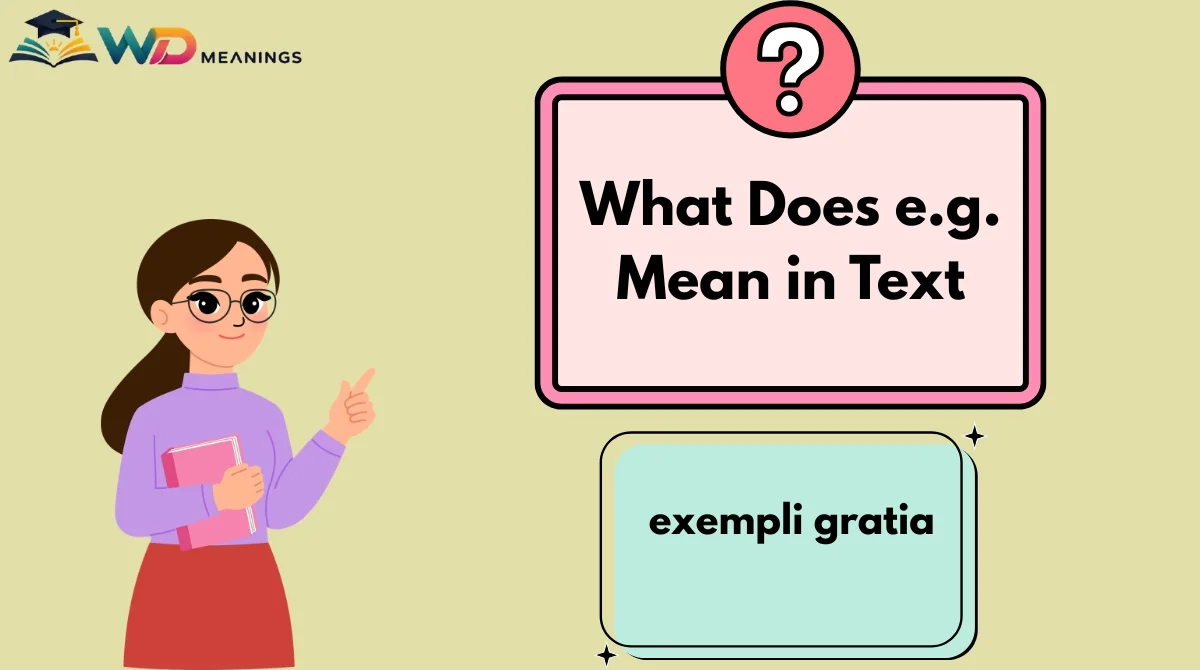
If you’re searching for what does e.g. mean in text, the short answer is that e.g. means “for example.”
It’s used to introduce one or more examples without listing every possible option.
Although it’s more common in formal writing than casual texting, many people still use it in messages when they want to keep their writing brief.
This guide explains exactly what e.g. means, where it came from, how people use it in conversations, whether it changes across different platforms, and how you should respond when someone uses it.
Quick Answer
e.g. is a Latin abbreviation for exempli gratia, which means “for example.” In text messages, emails, and online conversations, it introduces one or more examples rather than a complete list. If someone writes, “Wear comfortable shoes, e.g., trainers,” they are simply giving trainers as one example of suitable footwear.
What Does e.g. Mean in Text?
In texting, e.g. means “for example.” It helps the writer clarify an idea by providing one or more examples.
Unlike many texting abbreviations such as LOL or BRB, e.g. isn’t an internet slang term. Instead, it’s a long-established abbreviation borrowed from Latin and commonly used in English writing.
Full Form
e.g. = exempli gratia
The Latin phrase translates to “for example.”
Simple Definition
When someone uses e.g., they’re introducing examples that help explain what they mean. The examples are illustrative, not exhaustive.
Pronunciation
People usually say:
- “For example”
- Occasionally “ee-jee” in casual speech
Most people don’t read the Latin phrase aloud.
Tone and Emotional Meaning
The abbreviation itself is emotionally neutral. It doesn’t express happiness, sarcasm, anger, or affection. Instead, it simply makes a message clearer.
Text Message Example
Alex: What should I bring?
Taylor: Bring something sweet, e.g., brownies or cookies.
Here, brownies and cookies are just examples—not the only acceptable choices.
Origin and Background
The abbreviation e.g. comes from the Latin phrase exempli gratia, meaning “for example.”
For centuries, English writers have used it in books, academic writing, business communication, and legal documents. As digital communication became more common, people naturally continued using it in emails, forums, messaging apps, and even some text conversations.
Although modern texting often favours plain English, many students, professionals, and experienced writers still use e.g. because it’s short and widely understood.
How e.g. Is Used in Text Conversations
The meaning remains the same regardless of who uses it. Its purpose is simply to introduce examples.
Friendly Conversation
Emma: What movies do you like?
Ryan: Action films, e.g., Mission: Impossible or John Wick.
Planning Events
Chris: What should everyone bring?
Mia: Drinks, e.g., lemonade or iced tea.
School Chat
Student: What sources can I use?
Teacher: Reliable websites, e.g., government or university sites.
Workplace Message
Please upload supporting documents, e.g., invoices or receipts.
Humorous Use
Bring survival essentials—e.g., coffee.
The humour comes from the example itself, not from e.g.
What Does e.g. Mean on Different Platforms?
The meaning of e.g. stays consistent across online platforms. Only the writing style may differ.
People occasionally use e.g. when explaining something quickly or listing examples.
Example:
“Let’s watch something funny, e.g., a comedy.”
Snapchat
Less common because conversations are usually short, but it still means “for example.”
Frequently appears in captions explaining products, routines, or recommendations.
Example:
“My favourite comfort foods, e.g., pasta and soup.”
TikTok
Creators may use e.g. in captions or comments to give examples.
Common in community groups, educational posts, and marketplace listings.
Discord
Often used in gaming servers, study groups, and technical discussions.
Example:
“Choose support characters, e.g., healers.”
Dating Apps
It’s relatively uncommon but may appear when someone lists interests.
Example:
“I enjoy outdoor activities, e.g., hiking and kayaking.”
The meaning remains “for example.”
What Does e.g. Mean From a Girl or Guy?
The meaning does not change based on gender.
Whether a girl, guy, friend, teacher, colleague, or family member writes e.g., it still means “for example.”
Instead of focusing on who sent the message, pay attention to:
- The surrounding conversation
- The examples provided
- The punctuation
- Any accompanying emojis
- The overall relationship and tone
For example:
“I like cosy dates, e.g., coffee shops ☕”
This isn’t romantic because of e.g.. The romantic feeling comes from the sentence itself.
Other Possible Meanings
Although “for example” is by far the most common meaning in texting, e.g. can appear in other contexts.
| Meaning | Context | Example |
|---|---|---|
| For example | Texting, emails, writing | Bring fruit, e.g., apples. |
| Example indicator | Academic writing | Use transition words, e.g., however. |
| Illustration in technical documents | Manuals and reports | Supported devices, e.g., tablets. |
In everyday messaging, “for example” is almost always the intended meaning.
How to Respond to e.g.
Usually, e.g. doesn’t require a special response. Instead, respond to the examples or the overall message.
Casual
“Sounds good!”
Friendly
“I’ll bring cookies then.”
Funny
“So coffee counts as survival equipment?”
Asking for Clarification
“Are those just examples, or do you specifically want those?”
Agreeing
“Perfect—that helps.”
Serious
“I understand. I’ll choose something similar.”
Example Chat
Jamie: Wear comfortable clothes, e.g., trainers and a hoodie.
Alex: Thanks! I’ll wear trainers.
Similar Texting Terms and Differences
| Term | Meaning | Key Difference |
|---|---|---|
| e.g. | For example | Gives examples |
| i.e. | That is | Clarifies or restates exactly |
| etc. | And so on | Continues a list rather than introducing examples |
| such as | Introduces examples | Plain English alternative to e.g. |
| for example | Introduces examples | Full English phrase instead of abbreviation |
A common mistake is confusing e.g. with i.e.
- e.g. = here are some examples
- i.e. = in other words; exactly what I mean
Common Misunderstandings
Several misunderstandings occur with e.g.
Confusing It with i.e.
This is the most common error.
Correct:
“I enjoy winter sports, e.g., skiing.”
Incorrect:
“I enjoy winter sports, i.e., skiing.”
The second sentence incorrectly suggests skiing is the only winter sport being discussed.
Thinking It Means “Especially”
It doesn’t.
It simply introduces examples.
Capitalisation
People sometimes write:
- e.g.
- E.g.
Both appear in practice, although e.g. is the standard form within sentences.
Forgetting the Comma
Many style guides recommend:
e.g., apples and bananas
However, punctuation conventions vary depending on the writing style being followed.
Is e.g. Appropriate or Safe to Use?
Yes. e.g. is completely appropriate, polite, and safe.
It isn’t:
- Rude
- Offensive
- Romantic
- Aggressive
- Sensitive
- Profane
It’s suitable for:
- School assignments
- Business emails
- Professional documents
- Study notes
- Most online discussions
In very casual texting, some people simply write “for example” because it’s easier for everyone to understand.
Examples of e.g. in Text
- We should play something relaxing, e.g., Animal Crossing.
- Bring warm clothes, e.g., a jacket and gloves.
- I enjoy outdoor sports, e.g., cycling.
- Choose healthy snacks, e.g., fruit or nuts.
- We need more decorations, e.g., balloons.
- Download a messaging app, e.g., WhatsApp.
- I’m learning languages, e.g., Spanish.
- Use reliable sources, e.g., university websites.
- Pick a dessert, e.g., cheesecake.
- Add relaxing music, e.g., piano playlists.
- Consider public transport, e.g., the train.
- We need volunteers, e.g., parents or teachers.
Frequently Asked Questions
Is e.g. the same as “for example”?
Yes. e.g. is simply the abbreviated Latin form of “for example.” Both introduce examples, and their meanings are identical. Many people prefer writing the full phrase in casual conversations because it’s immediately clear to everyone.
What’s the difference between e.g. and i.e.?
e.g. introduces examples, while i.e. explains or restates something more precisely. If you’re offering possible examples, use e.g.. If you’re defining exactly what you mean, use i.e.
Do people still use e.g. in text messages?
Yes, although it’s more common in emails, academic writing, and professional communication than in everyday texting. Some people prefer writing “for example” instead because it’s more conversational.
Should I include punctuation after e.g.?
Many English style guides recommend writing e.g., followed by a comma before the examples. However, punctuation conventions can vary depending on the style guide or regional preference you’re following.
Is e.g. formal or informal?
It’s generally considered neutral to slightly formal. You’ll often see it in essays, reports, business communication, and educational materials, but it’s also acceptable in many everyday messages.
Can I replace e.g. with “such as”?
Often, yes. Both introduce examples, although they don’t always fit every sentence in exactly the same way. In casual writing, “such as” often sounds more natural than the abbreviation.
Conclusion
If you’ve been wondering what does e.g. mean in text, the answer is straightforward:
it means “for example.” It’s used to introduce one or more examples that help explain an idea without listing every possibility.
Whether you see it in a text message, email, classroom discussion, or social media post, the meaning stays the same.
Understanding the difference between e.g., i.e., and similar expressions will help you read and write with greater confidence while avoiding common misunderstandings.

Hamz Ellis is a content writer at WD Meanings, specializing in internet slang, texting abbreviations, and digital communication. He creates clear, well-researched, and easy-to-understand content to help readers quickly find the meanings of modern online terms.