If you’ve received a message saying “TMI!” and wondered what it means, you’re not alone.
The phrase appears constantly in text messages, group chats, social media comments, and online conversations.
Understanding what does TMI mean in text can help you avoid confusion and better understand the tone of a conversation.
In most cases, TMI is a light-hearted way of telling someone they’ve shared more personal information than others wanted or expected to hear.
Depending on the situation, it can be playful, humorous, slightly embarrassed, or occasionally critical.
The meaning usually stays the same across platforms, but the context determines whether it’s friendly or rude.
This guide explains exactly what TMI means, where it came from, how people use it in texting, how to respond naturally, and when it’s appropriate to use.
Quick Answer
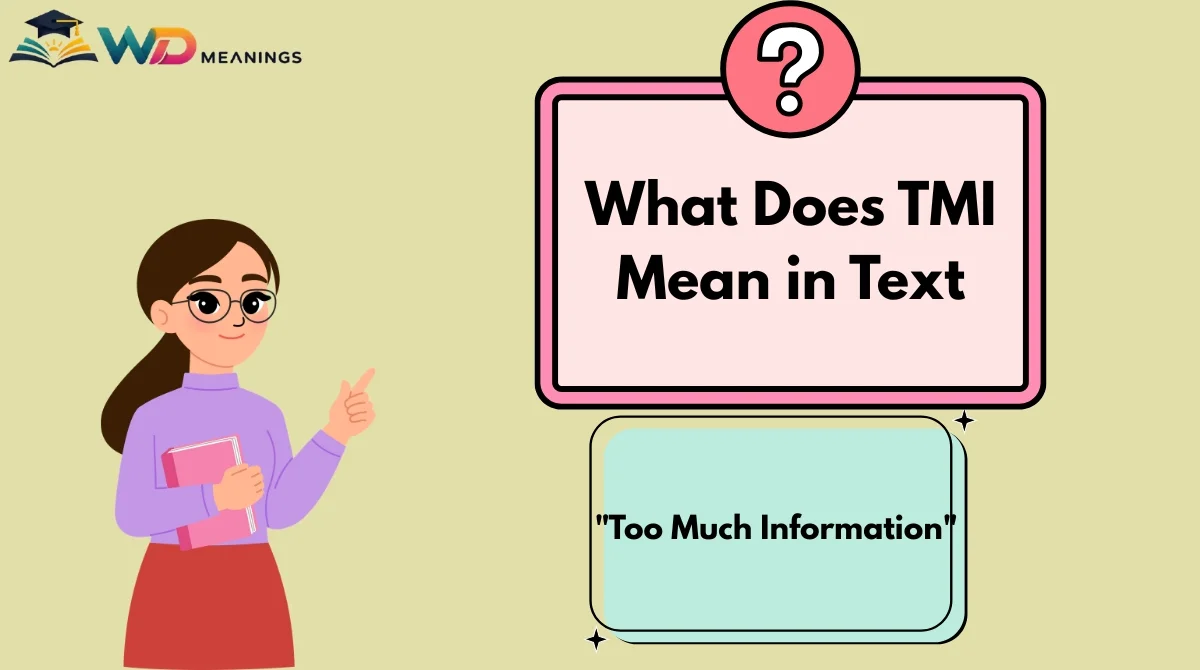
TMI stands for “Too Much Information.” In text messages and online chats, it’s used when someone shares overly personal, embarrassing, graphic, or unnecessary details. Most people use it jokingly among friends, although it can sometimes politely suggest that someone has crossed a personal boundary.
What Does TMI Mean in Text?
TMI is short for “Too Much Information.”
It tells someone that they’ve revealed more information than the listener wanted or needed to know. The phrase usually isn’t meant to be taken literally. Instead, it’s often used as a humorous reaction to an awkward or overly detailed story.
Pronunciation: tee-em-eye
Simple Definition
TMI means someone has shared personal, private, awkward, or overly detailed information that others may find uncomfortable or unnecessary.
The tone depends on the conversation:
- Friendly and playful
- Light-hearted teasing
- Mild embarrassment
- Gentle criticism
- Occasionally sarcastic
Example
Alex: I accidentally wore my shirt inside out all morning, and everyone saw.
Jamie: Haha, not too bad.
Alex: Then I realised I also had toothpaste on my face.
Jamie: 😂 TMI!
In this example, Jamie is joking that Alex is revealing more embarrassing details than necessary.
Origin and Background
The expression “Too Much Information” existed in everyday English long before texting became popular. People used the full phrase in conversation whenever someone revealed private or overly detailed information.
As texting, internet forums, instant messaging, and social media grew, people shortened the phrase to TMI to save time while typing. Like many internet abbreviations, the shortened version became widely recognised and is now commonly used across digital communication.
Although the exact point when the abbreviation first became popular online is difficult to identify, its meaning has remained remarkably consistent over the years.
How TMI Is Used in Text Conversations
People usually send TMI after hearing something that feels unnecessarily personal or awkward.
Friendly Conversation
Emma: I cried during that movie.
Lily: That’s sweet.
Emma: I used almost an entire box of tissues.
Lily: 😂 TMI!
Funny Conversation
Chris: I ate six slices of pizza.
Ben: Nice.
Chris: Then I couldn’t button my jeans.
Ben: TMI 😂
Romantic Conversation
Taylor: I still smile every time you text me.
Jordan: That’s adorable ❤️
Taylor: I’ve reread your messages like ten times.
Jordan: Haha, maybe a little TMI, but it’s cute.
Slightly Awkward Situation
Sam: I just spent twenty minutes describing my dentist appointment.
Alex: TMI… but I’m glad everything went well.
Mildly Sarcastic
Jordan: I want every single detail about your stomach bug.
Chris: Seriously?
Jordan: Just kidding. TMI already.
What TMI Means on Different Platforms
The meaning of TMI stays almost the same across major messaging and social media platforms. What changes is the type of conversation where it appears.
Friends and family often use TMI while chatting casually after someone overshares a funny or embarrassing story.
Snapchat
Snapchat users commonly reply with TMI to humorous photos, videos, or personal updates that reveal more than expected.
You’ll often see TMI in comments, direct messages, or replies to stories where someone shares an awkward or highly personal experience.
TikTok
Creators and viewers frequently use TMI in comments when videos contain embarrassing confessions, unusual personal stories, or humorous oversharing.
On Facebook, TMI often appears in comments on personal posts when someone shares details that some readers feel are overly private.
Discord
Gaming communities and friend groups use TMI jokingly during conversations whenever someone shares unnecessary personal information.
Dating Apps
On dating apps, TMI may suggest that someone revealed very personal details too early in the conversation. Whether that’s positive or negative depends on how comfortable both people feel.
What Does TMI Mean From a Girl or Guy?
The abbreviation itself does not change meaning based on gender.
Whether a girl or a guy sends TMI, they’re almost always reacting to the amount of information rather than expressing a hidden message.
Instead, pay attention to:
- Your relationship with the sender
- Their usual communication style
- Emojis
- Punctuation
- The surrounding conversation
For example:
“TMI 😂”
This usually sounds playful.
“TMI…”
This may suggest mild discomfort.
“LOL TMI 🤣”
This often means the sender found the story funny rather than offensive.
Context matters far more than who sent the message.
Other Possible Meanings
While “Too Much Information” is by far the most common meaning in texting, TMI can occasionally represent other phrases in specific professional or organisational settings.
| Meaning | Context | Example |
|---|---|---|
| Too Much Information | Texting, social media, everyday conversation | “Okay… TMI 😂” |
| Technical Manuals Index | Technical documentation | “Check the TMI before ordering parts.” |
| Training Management Information | Workplace or education systems | “The report was uploaded to the TMI portal.” |
In everyday text messages, Too Much Information is almost always the intended meaning.
How to Respond to TMI
Your reply depends on the mood of the conversation.
Casual
Haha, fair enough!
Funny
You asked for honesty! 😂
Friendly
Sorry, I got carried away.
Playful
Okay, I’ll spare you the rest.
Romantic
Oops… but I trust you enough to tell you everything. ❤️
Confused
Wait… what part was TMI?
Serious
Sorry if that made you uncomfortable.
Example Chat
Emma: TMI 😂
Sophia: Haha, I’ll stop there!
Similar Texting Terms and Differences
| Term | Meaning | Key Difference |
|---|---|---|
| TMI | Too Much Information | Someone overshared personal details |
| FYI | For Your Information | Shares useful information without suggesting oversharing |
| IMO | In My Opinion | Introduces a personal opinion |
| IDC | I Don’t Care | Shows disinterest rather than discomfort |
| TBH | To Be Honest | Signals honesty or a frank opinion |
Although these abbreviations appear in similar conversations, only TMI specifically refers to oversharing.
Common Misunderstandings
One common mistake is assuming TMI is always rude.
In reality, it’s often used jokingly between close friends. Many people laugh when someone replies with TMI because it’s part of playful conversation.
Another misunderstanding is thinking TMI means the information is false. It doesn’t. The phrase only comments on how much someone shared—not whether it’s true.
Capitalisation doesn’t change the meaning.
These are all understood the same way:
- TMI
- tmi
- Tmi
People also sometimes use extra punctuation for emphasis:
- TMI!
- TMI 😂
- OMG TMI
- LOL… TMI
The surrounding conversation helps determine whether the message is humorous or serious.
Is TMI Appropriate or Safe to Use?
TMI is generally considered an informal expression.
It’s appropriate for:
- Friends
- Family
- Casual chats
- Group messages
- Social media conversations
It’s usually less suitable for:
- Professional emails
- Business meetings
- Formal workplace communication
- Academic writing
Although TMI isn’t offensive by itself, using it after someone shares something emotional or deeply personal can sound insensitive. If someone is discussing a serious issue, it’s usually better to respond with empathy rather than dismissing their feelings by saying “TMI.”
When in doubt, consider the person’s emotional state before using the abbreviation.
Examples of TMI in Text
- “TMI! 😂 I didn’t need to know that.”
- “Okay… definitely TMI.”
- “Haha, that’s a little TMI, but thanks for sharing.”
- “You really tell me everything. TMI!”
- “LOL, total TMI.”
- “I appreciate your honesty, but maybe TMI.”
- “That story kept getting more detailed… TMI!”
- “Oops, I think that was TMI.”
- “TMI 🤣 Now I can’t stop laughing.”
- “You could’ve skipped that last part. TMI.”
- “That’s probably more information than I needed 😂.”
- “Thanks… I guess? TMI!”
Frequently Asked Questions
Is TMI a rude thing to say?
Not usually. Most people use TMI playfully among friends. However, saying it during a serious or emotional conversation can seem dismissive, so it’s important to consider the situation before using it.
Does TMI always mean something embarrassing?
No. It can refer to any information that’s considered overly personal, unnecessary, or excessively detailed. The information doesn’t have to be embarrassing to qualify as TMI.
Can TMI be used in professional conversations?
Generally, no. TMI is informal internet slang and is better suited to casual conversations. In professional settings, it’s usually more polite to express concerns without using slang.
Why do people say TMI instead of “Too Much Information”?
Like many texting abbreviations, TMI saves time and space. It’s also widely recognised, making it a quick and humorous reaction during online conversations.
Is TMI positive or negative?
It can be either. Friends often use it affectionately while joking with one another, but in other situations it may indicate discomfort or suggest that someone has crossed a conversational boundary.
Can I use TMI on social media?
Yes. TMI is common on platforms like Instagram, TikTok, Snapchat, Facebook, and Discord. Just be aware of the audience and whether the conversation is casual enough for informal slang.
Conclusion
Understanding what does TMI mean in text is simple once you know the context.
In almost every conversation, TMI stands for “Too Much Information” and signals that someone has shared more personal or detailed information than expected.
Most of the time it’s playful, humorous, and harmless, especially among friends.
However, tone and context always matter.
Paying attention to emojis, punctuation, and the overall conversation will help you decide whether TMI is being used jokingly, gently, or as a polite request to stop oversharing.

Hamz Ellis is a content writer at WD Meanings, specializing in internet slang, texting abbreviations, and digital communication. He creates clear, well-researched, and easy-to-understand content to help readers quickly find the meanings of modern online terms.