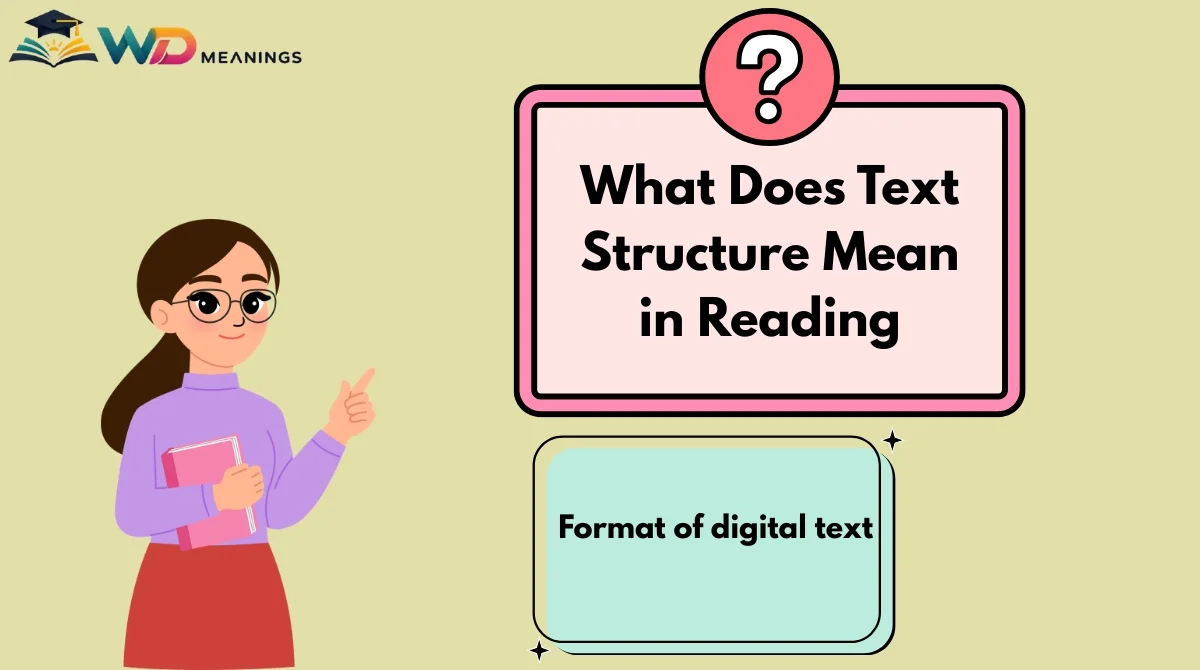
Many students and readers come across the phrase “what does text structure mean in reading” when learning how to understand articles, stories, textbooks, and other written materials.
Text structure refers to the way an author organizes information to help readers follow ideas, identify important points, and understand the overall message.
Recognizing text structure can make reading easier because it shows how information is connected.
A writer may explain causes and effects, compare two ideas, describe a topic, or present events in order.
Each structure gives readers clues about what to expect.
In this guide, you’ll learn what text structure means in reading, the different types of structures authors use, how to identify them, and why this skill matters for students, teachers, and everyday readers.
Quick Answer
Text structure in reading means the way an author organizes information in a text. It shows how ideas, details, events, and arguments are arranged. Common text structures include cause and effect, compare and contrast, problem and solution, description, and chronological order.
What Does Text Structure Mean in Reading?
Text structure is the organization or framework an author uses to arrange information in a written text. It explains how different parts of a passage connect and how the writer chooses to present ideas to the reader.
When you read a paragraph, article, story, or textbook chapter, the author does not place information randomly. They use a specific pattern to make their message clear.
For example:
- A history article may follow a chronological structure by explaining events from the past to the present.
- A science article may use a cause-and-effect structure to explain why something happens.
- An opinion article may use a problem-and-solution structure to discuss an issue and suggest answers.
Understanding text structure helps readers answer important questions:
- What is the author trying to explain?
- How are the ideas connected?
- Which information is most important?
- Why did the author organize the text this way?
Simple Definition of Text Structure
Text structure is the pattern or method an author uses to organize information in writing.
It is similar to a building plan. Just as a blueprint shows how rooms connect in a house, text structure shows how ideas connect in a piece of writing.
Pronunciation
The phrase text structure is pronounced:
tekst STRUK-chur
The word “structure” means the way something is built or arranged.
Example in Reading
Text:
“Many animals are losing their habitats because forests are being destroyed. As a result, some species are becoming endangered.”
This passage uses a cause-and-effect structure:
- Cause: Forests are destroyed.
- Effect: Animals lose habitats and become endangered.
Origin and Background of Text Structure
The idea of text structure comes from the study of reading comprehension, writing organization, and education. Teachers and researchers have long studied how readers understand information and how authors arrange ideas.
There is no single person who invented text structure. Instead, it developed as educators explored ways to help students become stronger readers.
In schools, identifying text structure became an important reading strategy because students who understand organization patterns often find it easier to:
- summarize information,
- identify main ideas,
- remember details,
- analyze arguments,
- and predict what may come next.
Today, text structure is commonly taught in elementary schools, high schools, universities, and reading programs because it applies to almost every type of writing.
How Text Structure Is Used in Reading
Authors use different text structures depending on their purpose. The structure helps guide readers through information.
Here are the most common types of text structures:
Description Structure
A description structure provides details about a person, place, object, idea, or topic.
Example:
“The rainforest contains thousands of plant species, tall trees, colorful birds, and unique animals.”
The author’s goal is to help readers understand what something is like.
Common signal words:
- for example
- includes
- such as
- characteristics
- features
Sequence or Chronological Structure
A chronological structure presents information in time order.
It is often used in:
- biographies,
- historical writing,
- instructions,
- stories.
Example:
“First, the company opened its first store. Five years later, it expanded to other cities.”
Common signal words:
- first
- next
- then
- later
- finally
- before
- after
Cause and Effect Structure
This structure explains why something happens and what results from it.
Example:
“Heavy rainfall caused flooding in several areas.”
Cause:
Heavy rainfall.
Effect:
Flooding.
Common signal words:
- because
- therefore
- as a result
- due to
- leads to
Compare and Contrast Structure
This structure shows similarities and differences between two or more things.
Example:
“Both cats and dogs make popular pets, but dogs usually require more outdoor activity.”
Common signal words:
- both
- similarly
- however
- unlike
- different
- compared with
Problem and Solution Structure
This structure explains an issue and provides possible solutions.
Example:
“Plastic pollution is harming oceans. Recycling and reducing plastic use can help solve this problem.”
Common signal words:
- problem
- solution
- challenge
- answer
- resolve
What Does Text Structure Mean in Different Reading Contexts?
Text structure can appear in many types of reading materials.
Text Structure in School Reading
Students often learn text structures to understand:
- textbooks,
- essays,
- research articles,
- exam passages.
For example, a science textbook may use cause and effect, while a history chapter may use chronological order.
Text Structure in Fiction
Stories often use chronological structure because events happen over time.
However, fiction can also include:
- flashbacks,
- parallel storylines,
- problem and solution patterns,
- character development structures.
Text Structure in Online Articles
Web articles often combine several structures.
For example:
- An introduction may describe a topic.
- A middle section may compare options.
- A final section may provide solutions or recommendations.
What Does Text Structure Mean From a Student or Reader’s Perspective?
Text structure does not change based on who is reading it. However, different readers may notice different patterns depending on their experience and reading skills.
A beginner reader may focus mainly on individual sentences, while an experienced reader may quickly recognize the overall organization.
Understanding structure helps readers become more active instead of simply reading words.
A strong reader asks:
- Why did the author arrange information this way?
- What relationship exists between these ideas?
- What information does the author want me to remember?
Other Possible Meanings of Text Structure
The phrase text structure usually refers to organization in reading and writing. However, it can have slightly different meanings depending on context.
| Meaning | Context | Example |
|---|---|---|
| Organization of written information | Reading and education | “The article uses a problem-solution text structure.” |
| Arrangement of sentences and paragraphs | Writing classes | “The essay needs a clearer text structure.” |
| Format of digital text | Technology or design | “The website’s text structure affects readability.” |
The most common meaning in reading is the way an author organizes ideas and information.
How to Identify Text Structure While Reading
Finding text structure becomes easier when you look for clues.
1. Look for Signal Words
Certain words reveal organization patterns.
Examples:
- “because” often suggests cause and effect.
- “however” often suggests comparison.
- “first” and “finally” often suggest sequence.
2. Ask What the Author Is Doing
Think about the author’s purpose:
- Are they describing something?
- Are they explaining reasons?
- Are they comparing ideas?
- Are they presenting a solution?
3. Notice How Information Is Arranged
Pay attention to:
- paragraph order,
- headings,
- repeated ideas,
- examples,
- transitions.
Similar Reading Terms and Differences
| Term | Meaning | Key Difference |
|---|---|---|
| Text Structure | How information is organized | Focuses on the overall arrangement of ideas |
| Main Idea | The central point of a text | Focuses on what the text is mostly about |
| Text Features | Visual tools like headings and charts | Helps readers navigate information |
| Summary | A shortened version of key points | Focuses on important details after reading |
| Author’s Purpose | The reason a writer creates a text | Explains why the author wrote it |
Common Misunderstandings About Text Structure
Many readers confuse text structure with other reading skills.
Text Structure Is Not the Same as Main Idea
The main idea tells you what the text is about.
Text structure tells you how the author organizes that information.
Example:
A passage may be about climate change (main idea), but it may use cause and effect as its structure.
Text Structure Is Not Just Paragraph Length
A short paragraph can have a clear structure, and a long article can contain multiple structures.
Structure depends on how ideas connect, not how long the writing is.
A Text Can Have More Than One Structure
Some texts combine different patterns.
For example:
A health article may:
- describe a condition,
- explain its causes,
- compare treatments,
- suggest solutions.
Is Understanding Text Structure Important?
Yes. Recognizing text structure is an important reading skill because it improves comprehension and critical thinking.
It helps readers:
- understand difficult information,
- study more effectively,
- write better essays,
- identify important details,
- organize their own writing.
This skill is especially useful for students preparing for exams because many reading questions test whether students understand how information is organized.
Examples of Text Structure in Reading
Example 1: Cause and Effect
“Many people experience stress because they have busy schedules. As a result, they may have trouble sleeping.”
Structure: Cause and effect.
Example 2: Compare and Contrast
“Online classes provide flexibility, while traditional classrooms offer face-to-face interaction.”
Structure: Compare and contrast.
Example 3: Problem and Solution
“Traffic congestion is increasing in major cities. Expanding public transportation can reduce the number of cars on the road.”
Structure: Problem and solution.
Example 4: Sequence
“First, mix the ingredients. Next, bake the mixture for 30 minutes.”
Structure: Sequence.
Example 5: Description
“The mountain village has peaceful streets, traditional houses, and beautiful views.”
Structure: Description.
Example 6: History Passage
“The invention was created in 1905. Later, improvements made it more useful.”
Structure: Chronological order.
Example 7: Science Passage
“Plants need sunlight to create energy. Without sunlight, they cannot grow properly.”
Structure: Cause and effect.
Example 8: Opinion Article
“Many schools are considering longer lunch breaks. Supporters believe they improve student focus.”
Structure: Problem and solution/opinion.
Example 9: Biography
“She was born in London, studied engineering, and later became a successful inventor.”
Structure: Chronological order.
Example 10: Comparison Article
“Electric cars produce fewer emissions than traditional vehicles, but they may require charging stations.”
Structure: Compare and contrast.
Frequently Asked Questions
What is the easiest way to find text structure?
The easiest way is to look for signal words and ask how the author connects ideas. Words like “because,” “however,” “first,” and “solution” often reveal the structure.
Why do teachers teach text structure?
Teachers teach text structure because it helps students understand, remember, and analyze information. It also improves writing skills by showing students how to organize their own ideas.
Can one text have multiple structures?
Yes. Many texts use more than one structure. For example, an article may describe a topic, explain causes, compare options, and suggest solutions.
Is text structure only used in nonfiction?
No. While it is common in nonfiction, fiction also has structure. Stories often follow a sequence of events, include problems and solutions, and develop characters over time.
What are the five main text structures?
The five common text structures are description, sequence, cause and effect, compare and contrast, and problem and solution.
How does text structure help reading comprehension?
Text structure helps readers understand relationships between ideas. Instead of seeing information as separate facts, readers can understand how those facts connect.
Conclusion
Understanding what text structure means in reading helps readers recognize how authors organize information.
Text structure shows whether a writer is describing, comparing, explaining causes, presenting solutions, or arranging events in order.
By identifying these patterns, readers can understand texts faster and remember important ideas more easily.
Whether you are reading a textbook, article, story, or online content, recognizing structure makes the reading experience clearer and more meaningful.

Hamz Ellis is a content writer at WD Meanings, specializing in internet slang, texting abbreviations, and digital communication. He creates clear, well-researched, and easy-to-understand content to help readers quickly find the meanings of modern online terms.