If you have seen ROFL in a text message, social media comment, or online chat, you may wonder what it actually means.
The abbreviation looks unusual at first, but it is one of the most popular internet expressions used to show strong laughter.
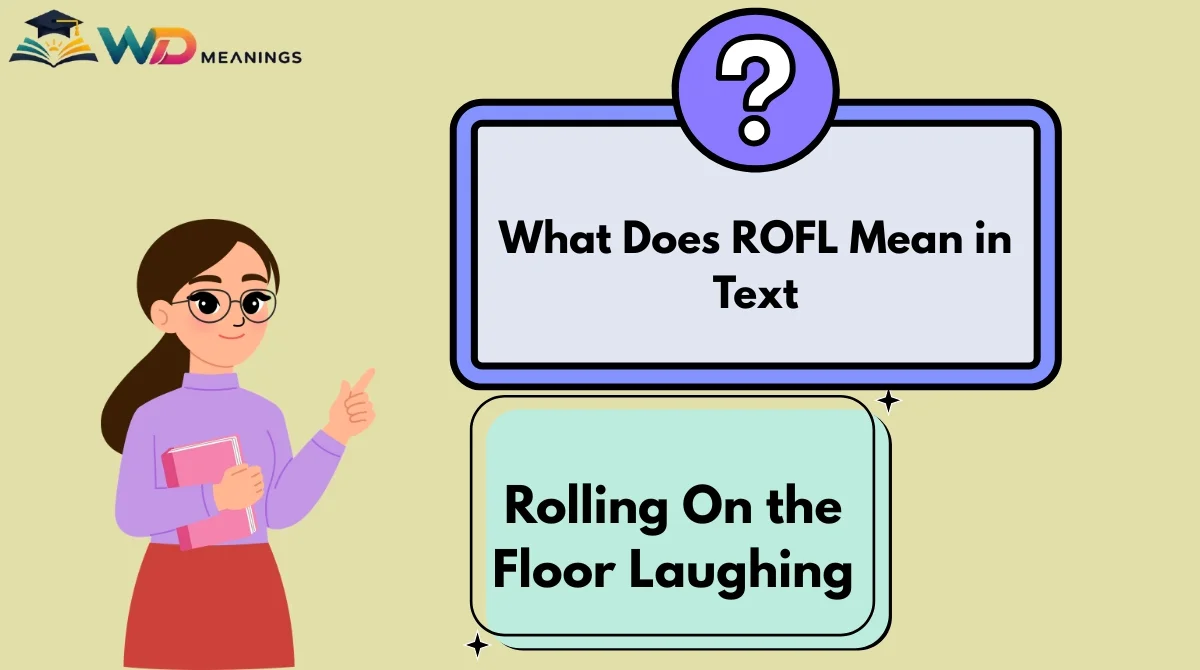
So, what does ROFL mean in text? In most conversations, ROFL means “Rolling On the Floor Laughing.”
People use it when something is extremely funny, surprising, or ridiculous.
This guide explains the meaning of ROFL, where it came from, how people use it across platforms like WhatsApp, Instagram, TikTok, and Discord, what it means from a girl or guy, and how to reply naturally.
Whether you are learning texting slang or trying to understand online conversations, you will find everything you need here.
Quick Answer
ROFL means “Rolling On the Floor Laughing” in text messages and online chats. It is used to show that something is very funny. It is stronger than “LOL” and usually expresses a big reaction to a joke, funny story, meme, or situation.
What Does ROFL Mean in Text?
ROFL stands for “Rolling On the Floor Laughing.” It is an internet abbreviation used when someone finds something extremely funny.
The phrase does not literally mean that the person is physically rolling on the floor. Instead, it is a playful exaggeration that communicates intense laughter.
Simple definition
ROFL = I am laughing a lot because this is extremely funny.
People usually type ROFL after:
- A hilarious joke
- A funny video or meme
- An unexpected situation
- A clever comment
- A silly mistake
How to pronounce ROFL
Most people pronounce ROFL by saying each letter:
“R-O-F-L”
Some people may casually pronounce it like “roffle,” but spelling out the letters is more common.
Emotional meaning and tone
ROFL usually has a:
- Funny tone
- Friendly tone
- Playful tone
- Excited reaction
It generally shows positive emotion. However, like many internet expressions, the meaning can change depending on context.
For example:
Friend: “I tried to cook dinner and accidentally burned the entire pizza.”
You: “ROFL 😂 How did that even happen?”
Here, ROFL shows amusement and friendly teasing.
Origin and Background of ROFL
ROFL became popular during the early days of internet communication, especially in online chat rooms, forums, instant messaging services, and gaming communities.
Like many internet abbreviations, it developed because people wanted faster ways to express emotions while typing. Instead of writing “I am rolling on the floor laughing,” users shortened the phrase into ROFL.
The expression became especially common during the growth of:
- Online forums
- Instant messaging
- Gaming chats
- Social media platforms
Its popularity grew alongside other internet laughter terms such as LOL (Laugh Out Loud), LMAO (Laughing My Ass Off), and LMFAO.
Although people rarely mean the phrase literally, ROFL remains a recognizable way to show strong laughter online.
How ROFL Is Used in Text Conversations
ROFL is mostly used in casual conversations when someone wants to show that something made them laugh.
Friendly conversations
Person 1: “My dog barked at his own reflection for five minutes.”
Person 2: “ROFL 😂 Your dog is confused.”
Here, ROFL creates a playful and friendly reaction.
When reacting to jokes
Friend: “Why did the computer go to the doctor? Because it had a virus.”
Reply: “ROFL, that was actually funny.”
The person is showing that they enjoyed the joke.
Romantic conversations
ROFL can also appear in flirting or romantic chats when someone finds their partner’s message funny.
Person 1: “I just waved at someone who wasn’t waving at me.”
Person 2: “ROFL 😂 That sounds exactly like something you would do.”
It can create a relaxed, comfortable mood.
Sarcastic use
Sometimes people use ROFL sarcastically.
Example:
Person 1: “I finished my homework at 3 AM and totally feel amazing.”
Person 2: “ROFL sure you do.”
The laughter may not mean genuine amusement. It can suggest playful disbelief.
Negative or mocking situations
In some cases, ROFL can feel rude if someone uses it to laugh at another person’s problem.
Example:
Person: “I failed my exam.”
Reply: “ROFL”
This could come across as insensitive because the person is laughing at someone’s difficulty.
Context matters.
What Does ROFL Mean on Different Platforms?
The meaning of ROFL usually stays the same across platforms. It almost always refers to strong laughter. However, the way people use it may vary depending on the community.
ROFL on WhatsApp
On WhatsApp, ROFL is commonly used in private chats and group conversations.
People often use it when reacting to:
- Funny messages
- Voice notes
- Memes
- Photos
- Personal stories
Example:
Friend: “I locked myself outside my house wearing slippers and pajamas.”
Reply: “ROFL 😂”
ROFL on Snapchat
Snapchat users may use ROFL when replying to funny snaps or stories.
It often appears with emojis like:
- 😂
- 🤣
- 😭
Example:
“Your snap filter made you look like a cartoon. ROFL 😂”
ROFL on Instagram
On Instagram, ROFL may appear in:
- Comments
- Direct messages
- Reactions to reels
Users often use it when a reel or meme is extremely funny.
Example:
“ROFL this reel is too accurate.”
ROFL on TikTok
TikTok users often prefer emojis or phrases like “I’m crying” or “dead,” but ROFL is still understood.
Example:
“ROFL the ending was unexpected.”
ROFL on Facebook
Facebook users commonly use ROFL in comments, especially when reacting to funny posts, family jokes, or viral content.
ROFL on Discord
In gaming and community chats, ROFL is often used after funny moments, mistakes, or unexpected events.
Example:
“ROFL you just walked into your own trap.”
ROFL on Dating Apps
On dating apps, ROFL can help show personality and a sense of humour.
Example:
Person 1: “My biggest talent is forgetting why I walked into a room.”
Person 2: “ROFL, same.”
It usually creates a relaxed and playful conversation.
What Does ROFL Mean From a Girl or Guy?
ROFL does not have a different meaning based on whether it comes from a girl or a guy.
The meaning depends more on:
- The relationship between the people
- The conversation topic
- The person’s communication style
- Emojis and punctuation
If a girl sends ROFL
It usually means she found something genuinely funny.
Example:
“You are seriously hilarious. ROFL 😂”
This may simply show enjoyment and comfort in the conversation.
If a guy sends ROFL
It usually means the same thing: he is laughing strongly.
Example:
“ROFL, I can’t believe you actually did that.”
Does ROFL mean flirting?
Not by itself.
ROFL is not automatically romantic. However, if it appears alongside teasing, compliments, playful jokes, or frequent conversation, it may be part of a friendly or flirty interaction.
Always look at the whole conversation instead of one abbreviation.
Other Possible Meanings of ROFL
The most common meaning of ROFL in texting is Rolling On the Floor Laughing.
Other meanings exist, but they are much less common.
| Meaning | Context | Example |
|---|---|---|
| Rolling On the Floor Laughing | Texting, social media, online chats | “That video was hilarious ROFL” |
| Rolling On Floor Laughing | Informal variation without “the” | “ROFL, that joke was great” |
| A name or abbreviation in specific organisations | Rare professional contexts | Depends on the organisation |
For normal conversations, messages, and social media, ROFL almost always means laughter.
How to Respond to ROFL
Your reply depends on the situation and your relationship with the person.
Casual replies
- “😂 Glad you liked it!”
- “I knew you would laugh.”
- “Haha, it was too funny.”
Funny replies
- “Mission accomplished. I made you laugh.”
- “I’ll accept that ROFL as approval.”
- “My comedy career starts now.”
Friendly replies
- “Haha, thanks for appreciating my terrible jokes.”
- “You always get my humour.”
Romantic or playful replies
- “I knew I could make you smile 😉”
- “Your laugh is the best reaction.”
If you do not understand
- “Wait, what does ROFL mean?”
- “I know LOL, but what is ROFL?”
Similar Texting Terms and Differences
| Term | Meaning | Key Difference |
|---|---|---|
| LOL | Laugh Out Loud | Common and lighter laughter |
| LMAO | Laughing My Ass Off | Stronger laughter than LOL |
| LMFAO | Laughing My Freaking Ass Off | Very strong and more informal |
| ROFL | Rolling On the Floor Laughing | Shows extreme amusement |
| 😂 | Face With Tears of Joy emoji | Visual laughter reaction |
ROFL and LOL are similar, but ROFL usually suggests a bigger reaction.
Common Misunderstandings About ROFL
Many people misunderstand ROFL because internet slang changes quickly.
ROFL does not mean someone is literally on the floor
It is an exaggeration, just like saying “I’m dying laughing.”
Capital letters are not required
You may see:
- ROFL
- rofl
- Rofl
They all usually mean the same thing.
ROFL is not always serious laughter
Sometimes people use it jokingly or sarcastically.
Example:
“ROFL, yeah right.”
This may show disbelief rather than actual laughter.
ROFL vs LOL
Some people think they are identical. They are related, but ROFL usually feels more intense.
Is ROFL Appropriate or Safe to Use?
ROFL is generally safe and harmless in casual communication.
It is:
- Informal
- Friendly
- Common online
- Not offensive by itself
However, it may be inappropriate in certain situations.
Workplace communication
ROFL may be too casual for professional emails or formal messages.
Instead, consider:
- “That’s funny.”
- “That made me laugh.”
- “I appreciate the humour.”
Sensitive situations
Avoid using ROFL when someone is sharing:
- Serious problems
- Emotional struggles
- Bad news
Laughing at someone’s pain can appear disrespectful.
The meaning depends on what you are reacting to.
Examples of ROFL in Text
- “ROFL 😂 That was the funniest video I’ve seen today.”
- “You actually forgot your own birthday? ROFL.”
- “ROFL, your cat’s reaction was priceless.”
- “I just tripped while walking normally. ROFL.”
- “That meme is so accurate. ROFL 🤣”
- “ROFL, I cannot believe you said that in front of everyone.”
- “Your story gets funnier every time. ROFL.”
- “ROFL 😂 The dog running away with the sandwich was perfect.”
- “I was trying to be serious, but your message made me ROFL.”
- “ROFL, that comeback was amazing.”
- “You and your random ideas always make me laugh. ROFL.”
- “ROFL, I needed that laugh today.”
Frequently Asked Questions
What does ROFL mean in texting?
ROFL means “Rolling On the Floor Laughing.” People use it in texts and online chats to show that something is extremely funny. It is a stronger laughter reaction than simple terms like LOL.
Is ROFL stronger than LOL?
Yes, usually. LOL means someone is laughing, while ROFL suggests a much bigger reaction. However, people often use both casually, and the intensity depends on the person’s style.
Does ROFL mean someone likes you?
Not necessarily. ROFL only shows amusement. If someone uses it during playful conversations, it may show comfort and friendliness, but it is not automatically a sign of romantic interest.
Is ROFL still used today?
Yes. ROFL is still understood online, although many younger users also use emojis, “I’m crying,” or “dead” to express laughter.
Can ROFL be rude?
Yes, depending on the situation. Using ROFL when someone is upset or sharing serious news may seem disrespectful because it can appear like you are laughing at them.
What is the difference between ROFL and LMAO?
Both show strong laughter. ROFL means “Rolling On the Floor Laughing,” while LMAO means “Laughing My Ass Off.” Their meanings are similar, but LMAO is sometimes considered more informal.
Conclusion
ROFL means “Rolling On the Floor Laughing” and is one of the most recognizable ways to show strong laughter in text conversations.
People use it for funny jokes, memes, stories, and surprising moments.
The meaning usually stays the same across platforms like WhatsApp, Instagram, TikTok, Discord, and Snapchat. However, the tone depends on context.
ROFL can be playful and friendly, but it may feel rude if used in serious situations.
When someone sends ROFL, they are usually saying that your message made them laugh a lot.
Understanding the conversation around it is the best way to interpret the true meaning.

Hamz Ellis is a content writer at WD Meanings, specializing in internet slang, texting abbreviations, and digital communication. He creates clear, well-researched, and easy-to-understand content to help readers quickly find the meanings of modern online terms.