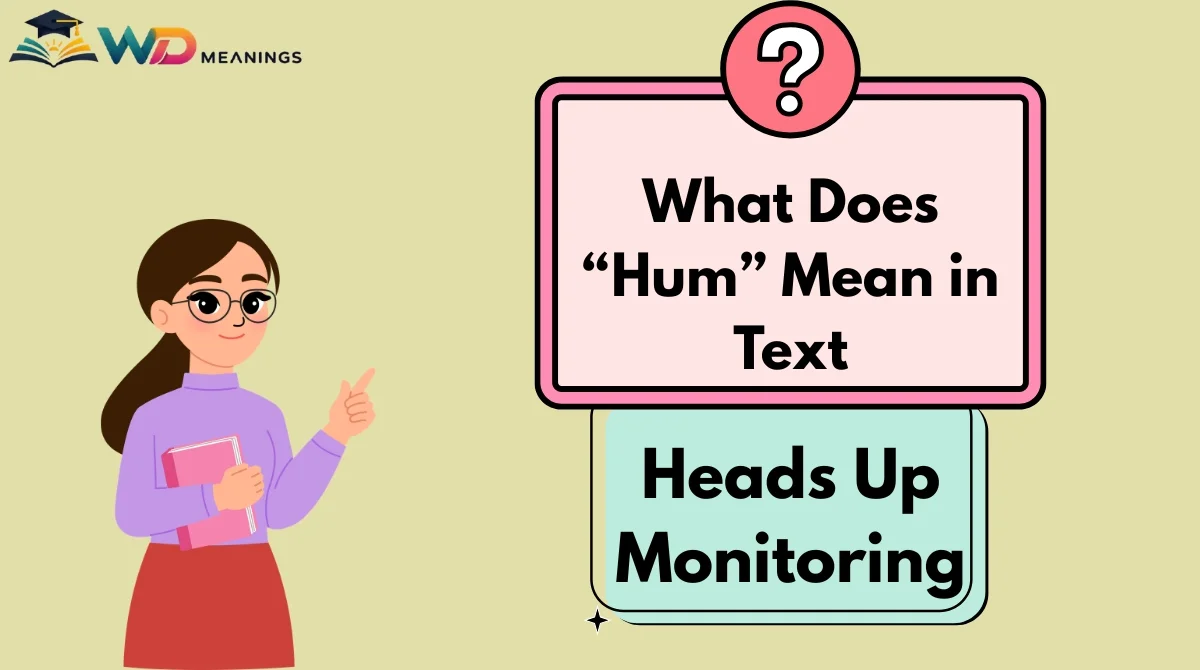
When you come across “hum” in a text message, it can be confusing because it doesn’t always have a single fixed meaning.
Unlike popular abbreviations such as “LOL” or “BRB,” hum is usually a conversational expression rather than an official acronym.
Most often, it represents a thoughtful sound similar to “hmm,” showing that someone is thinking, unsure, hesitant, or considering what to say next.
The exact meaning depends on the conversation, the relationship between the people chatting, and even the punctuation or emojis that accompany it.
In some messages, “hum” simply fills a pause. In others, it may suggest curiosity, mild disagreement, uncertainty, or playful teasing.
This guide explains what does hum mean in text, how people use it across different messaging platforms, what it can mean from a girl or a guy, how to respond naturally, and the situations where context matters most.
Quick Answer
Hum in text usually represents the sound “hmm.” It expresses thinking, hesitation, uncertainty, curiosity, or quiet agreement rather than serving as an abbreviation. Its meaning comes almost entirely from the conversation around it, making context, punctuation, and emojis important when interpreting the message.
What Does “Hum” Mean in Text?
The most common meaning of hum in texting is a written version of the sound someone makes while thinking.
Full Form
There is no official full form for “hum.” It is not an acronym.
Simple Definition
Hum is a text expression used to show that someone is:
- Thinking
- Unsure
- Considering an idea
- Pausing before answering
- Politely acknowledging a message
Some people type hum instead of hmm, while others use it because that’s simply how they naturally express the sound.
Pronunciation
It’s pronounced much like the word “hum” (the sound made while humming), although in texting it usually carries the same meaning as “hmm.”
Emotional Tone
Depending on context, hum may sound:
- Thoughtful
- Curious
- Unsure
- Playful
- Skeptical
- Mildly hesitant
Example
Alex: Should we go hiking this weekend?
Jordan: Hum… the weather might not be great.
Here, hum shows Jordan is thinking before giving an opinion.
Origin and Background
Unlike many internet abbreviations, hum did not originate as a formal piece of online slang. It is simply a written version of a natural vocal sound people make while thinking.
Across different languages and cultures, people often write reflective sounds differently:
- Hmm
- Hmmm
- Hum
- Umm
- Erm
Because texting encourages informal writing, users often spell sounds however they naturally hear or pronounce them. As a result, hum has become one of several accepted ways to express hesitation or contemplation in digital conversations.
Its exact history is uncertain, and there is no single event or platform where it first appeared.
How “Hum” Is Used in Text Conversations
Since hum reflects a person’s thoughts rather than a fixed definition, it can express several emotions.
Thinking Before Replying
Someone may type “hum” while deciding what to say.
Friend 1: Want pizza?
Friend 2: Hum… maybe sushi instead?
Showing Uncertainty
It can indicate that the sender hasn’t made up their mind.
A: Should I quit my job?
B: Hum, that’s a big decision.
Gentle Disagreement
Instead of saying “I disagree,” someone may soften their response.
A: That movie was amazing.
B: Hum… I didn’t enjoy it that much.
Curious Reaction
Sometimes “hum” simply means the person finds something interesting.
A: I met my old teacher today.
B: Hum, that’s unexpected!
Playful Conversation
Friends sometimes use it dramatically for humor.
A: Guess who ate the last cookie?
B: Hum… I wonder who that could be. 😄
What Does “Hum” Mean on Different Platforms?
The meaning of hum generally stays consistent across messaging apps. The platform rarely changes its definition.
Usually indicates someone is thinking or pausing before replying.
Example:
Hum… I’ll check my schedule first.
Snapchat
Often used casually between friends to react thoughtfully to a snap or message.
Example:
Hum, that’s interesting.
Appears in direct messages or comment replies to show curiosity or hesitation.
Example:
Hum… I never noticed that.
TikTok
Less common in videos but may appear in comments expressing doubt or surprise.
Example:
Hum… are we sure that’s real?
Used much like normal conversation, especially in Messenger.
Example:
Hum, I remember something different.
Discord
Often appears during discussions when someone is considering an answer.
Example:
Hum… let me think.
Dating Apps
On dating apps, hum usually signals that someone is thinking about what to say next rather than expressing strong emotion.
For example:
Hum… that’s actually a great question.
What Does “Hum” Mean From a Girl or Guy?
The meaning of hum doesn’t change simply because it comes from a girl or a guy.
Instead, pay attention to:
- Previous conversation
- Relationship
- Emojis
- Punctuation
- Overall tone
For example:
“Hum.”
May sound short or uncertain.
“Hum…”
Suggests thoughtful hesitation.
“Hum 😊”
Feels warm and friendly.
“Hum 🤔”
Shows genuine thinking.
“Hum 😂”
Usually playful.
Instead of focusing on gender, consider how the message fits into the conversation.
Other Possible Meanings
Although the thinking sound is by far the most common texting meaning, hum can occasionally have other meanings.
| Meaning | Context | Example |
|---|---|---|
| Thinking sound (most common) | Text conversations | “Hum… I’m not sure.” |
| Quiet humming sound | Talking about music | “I could hear her hum softly.” |
| Background noise | Technical discussions | “The speakers have a low hum.” |
| Expression of hesitation | Casual chat | “Hum, maybe later.” |
The thinking sound is the meaning most people intend when using hum in messages.
How to Respond to “Hum”
Your reply depends on what the sender seems to mean.
Casual
Take your time.
Friendly
What are you thinking?
Funny
That’s the universal thinking sound. 😄
Curious
Not convinced?
Romantic
You’re making me curious now.
Reassuring
No rush. Think it over.
If You’re Confused
What do you mean by “hum”?
Serious Conversation
I understand. Let me know once you’ve decided.
Similar Texting Terms and Differences
| Term | Meaning | Key Difference |
|---|---|---|
| Hmm | Thinking or hesitation | Most common spelling |
| Umm | Searching for words | Often expresses uncertainty while speaking |
| Erm | British hesitation sound | More common in spoken English |
| Eh | Asking for confirmation or showing doubt | Often invites a response |
| Oh | Realization or surprise | Usually indicates understanding rather than thinking |
Although these expressions are similar, each carries a slightly different emotional tone.
Common Misunderstandings
Because hum is informal, misunderstandings are possible.
Assuming It’s an Acronym
Many people search for a hidden full form.
In reality, hum usually isn’t an abbreviation at all.
Confusing It With “Hmm”
Most of the time, the two are interchangeable.
Thinking It Means Someone Is Angry
Not necessarily.
A simple “hum…” often means the sender is thinking—not upset.
Capitalization Doesn’t Matter
You’ll see variations like:
- hum
- Hum
- HUM
These usually carry the same meaning.
Context Is Everything
Compare these:
Hum… maybe.
Shows uncertainty.
Hum 😂
Shows playful humor.
Hum.
May sound more serious or reserved.
Is “Hum” Appropriate or Safe to Use?
Yes. Hum is generally a safe, polite, informal expression.
It is:
- Not offensive
- Not rude
- Not vulgar
- Suitable among friends
- Acceptable in casual chats
However, it isn’t ideal for very formal emails or professional business writing, where complete sentences communicate more clearly.
If someone repeatedly responds only with “hum” during an emotional conversation, they may simply be processing their thoughts. Rather than assuming a negative meaning, asking a gentle follow-up question can help clarify how they’re feeling.
Examples of “Hum” in Text
- Hum… I’ll think about it.
- Hum, that’s actually a good idea.
- Hum… I’m not completely sure.
- Hum 😂 You almost fooled me.
- Hum, give me a minute.
- Hum… that sounds interesting.
- Hum 🤔 Let me check first.
- Hum… I didn’t expect that.
- Hum, maybe tomorrow works better.
- Hum… what made you ask?
- Hum 😊 Thanks for telling me.
- Hum… we’ll figure it out together.
Frequently Asked Questions
Is “hum” the same as “hmm”?
Yes, in most text conversations they mean nearly the same thing. Both represent a thoughtful sound that suggests someone is thinking, hesitating, or considering a response. Individual spelling preferences vary, but the intended meaning is usually identical.
Is “hum” an abbreviation?
No. In texting, hum is generally not an acronym or abbreviation. It is simply a written expression that imitates the sound someone makes while thinking.
Is “hum” rude?
Usually not. It is typically neutral and polite. However, if someone replies with only “hum” and nothing else, it might feel distant or uncertain depending on the conversation.
Why do people type “hum” instead of “hmm”?
People often spell conversational sounds differently. Some naturally type hum, while others prefer hmm, hmmm, or umm. The intended meaning usually remains the same.
What should I reply when someone texts “hum”?
A good response depends on the situation. If the person seems thoughtful, you can say, “Take your time,” “What are you thinking?” or “Is something on your mind?” Matching their tone usually keeps the conversation comfortable.
Does “hum” mean someone likes me?
Not by itself. Hum simply shows thought or hesitation. To understand whether someone is interested romantically, look at the rest of the conversation, their overall behaviour, and other messages rather than relying on this single expression.
Conclusion
The answer to what does hum mean in text is usually quite simple: it’s a written version of a thoughtful sound, much like “hmm.”
Rather than functioning as an acronym, it helps express hesitation, curiosity, uncertainty, or quiet reflection.
Its exact meaning depends on the surrounding conversation, punctuation, emojis, and the relationship between the people chatting.
When you receive “hum” in a message, don’t rush to interpret it negatively.
Read it in context, and if you’re unsure, a friendly follow-up question is the easiest way to understand what the sender really means.

Hamz Ellis is a content writer at WD Meanings, specializing in internet slang, texting abbreviations, and digital communication. He creates clear, well-researched, and easy-to-understand content to help readers quickly find the meanings of modern online terms.