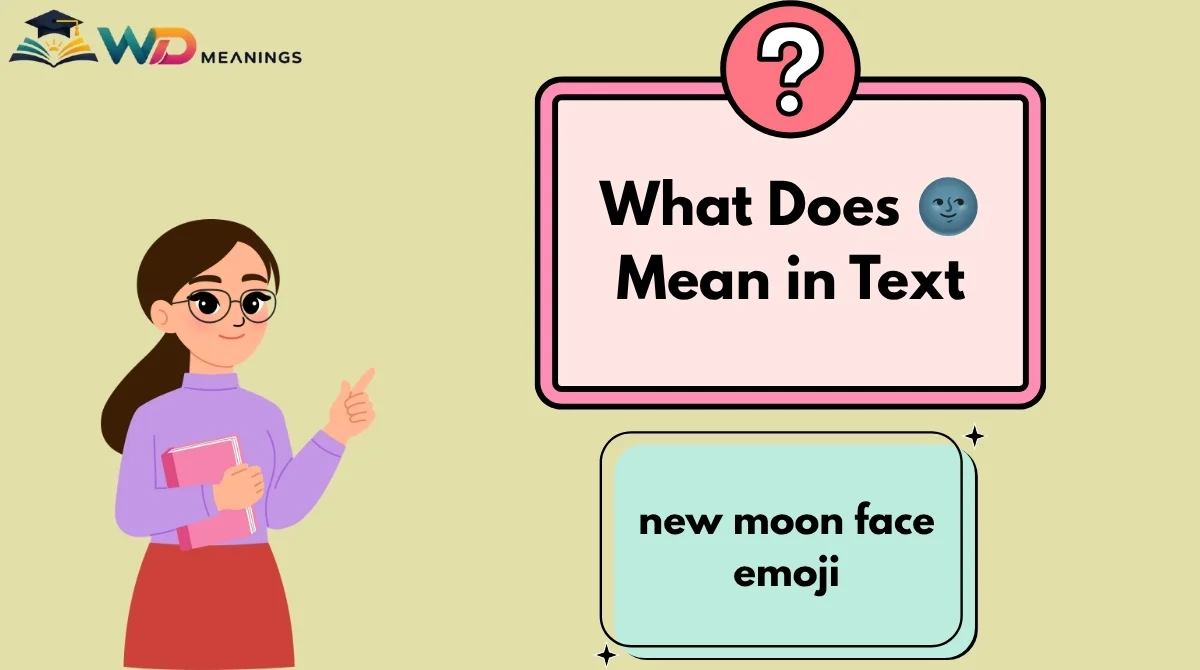
If you’ve ever received a 🌚 (new moon face emoji) in a text or social media message, you may have paused and wondered what the sender actually meant.
Unlike simple emojis such as 😊 or ❤️, the 🌚 emoji often carries a hidden tone that depends on the conversation, relationship, and context.
So, what does 🌚 mean in text? In most cases, it suggests awkwardness, playful sarcasm, teasing, a suspicious reaction, or an “I know something” expression.
People commonly use it after making a bold joke, a flirty comment, or saying something that could be interpreted in more than one way.
Rather than expressing a direct emotion, it adds a subtle layer of humor or mystery.
In this guide, you’ll learn the emoji’s most common meaning, how people use it across popular messaging apps, what it can mean from a girl or a guy, how to respond naturally, and when it may be misunderstood.
Quick Answer
The 🌚 emoji usually represents playful awkwardness, hidden intentions, sarcasm, or a mischievous reaction in text messages. It often appears after jokes, flirting, or comments with a double meaning. While it isn’t inherently negative, its exact meaning depends on the conversation and the relationship between the people chatting.
What Does 🌚 Mean in Text?
The 🌚 emoji is officially known as the New Moon Face emoji. It shows a dark new moon with a human face, giving it a slightly mysterious or knowing expression.
Unlike many emojis, it doesn’t have a fixed definition. Instead, it changes the tone of a message by suggesting that something is left unsaid.
Full Form
There is no full form because 🌚 is an emoji rather than an abbreviation.
Simple Definition
🌚 means “I’m joking,” “That was intentional,” “You know what I mean,” or “That sounded suspicious on purpose,” depending on the context.
People often use it to:
- Add playful mystery
- Signal sarcasm
- Make flirting less direct
- React to awkward moments
- Suggest a hidden meaning
- Tease someone without saying it outright
Pronunciation
Since it’s an emoji, people usually refer to it as:
- New Moon Face
- Moon Face Emoji
- Dark Moon Emoji (informal)
Emotional Tone
The 🌚 emoji often conveys:
- Playfulness
- Mischief
- Sarcasm
- Confidence
- Flirtation
- Secretive humor
- Slight awkwardness
It rarely expresses sadness or anger on its own.
Example
Alex: “You always reply faster when I’m online 🌚”
Taylor: “Haha… maybe I do 😂”
Here, the emoji gently hints at flirting without saying it directly.
Origin and Background
The 🌚 emoji comes from the Unicode New Moon Face emoji, originally created as one of several moon-phase emojis with human facial expressions.
Although it wasn’t designed with a specific texting meaning, internet users gradually gave it new interpretations. Over time, it became associated with memes, social media jokes, and subtle reactions that couldn’t easily be expressed with ordinary smiley faces.
Its popularity grew because the expression looks mysterious and slightly suspicious, making it perfect for situations where someone wants to imply:
- “I know something.”
- “That wasn’t innocent.”
- “You caught my meaning.”
- “I’m teasing.”
Since emoji meanings evolve naturally through online culture, there isn’t one official moment when 🌚 gained its current meaning. Instead, its interpretation developed through years of use on platforms like Twitter (now X), Tumblr, Snapchat, TikTok, and messaging apps.
How 🌚 Is Used in Text Conversations
The 🌚 emoji is extremely flexible. Here are the most common situations where people use it.
Playful Teasing
Someone wants to poke fun without sounding mean.
Emma: “You said you weren’t hungry, but you finished my fries 🌚”
Chris: “I can explain 😂”
Flirting
Many people add 🌚 after a compliment or suggestive joke.
Jordan: “You looked really good today 🌚”
This creates a playful, less serious tone.
Sarcasm
It can soften sarcastic comments.
Friend: “Sure… you’re always on time 🌚”
The emoji shows they’re joking rather than criticizing.
Suggesting a Hidden Meaning
Sometimes the sender intentionally leaves part of the message unsaid.
“Interesting… 🌚”
The emoji implies there’s more behind the statement.
Reacting to Awkward Moments
It can acknowledge embarrassment without making the situation uncomfortable.
“Well… that happened 🌚”
Instead of apologizing, the emoji adds humor.
Inside Jokes
Friends often use 🌚 because both already understand the reference.
“Don’t tell anyone 🌚”
The emoji makes the secret feel playful rather than serious.
What 🌚 Means on Different Platforms
The meaning of 🌚 usually stays similar across platforms, but the way people use it can change slightly depending on the online community and conversation style.
On WhatsApp, 🌚 is commonly used in private conversations between friends, family members, or couples. It often adds a teasing or joking tone to a message.
Common WhatsApp uses include:
- Reacting to a suspicious statement
- Making a playful accusation
- Adding humor to a confession
- Creating a flirty mood
Example:
Sam: “I only checked your profile once 🌚”
Alex: “Once? Sure 😂”
Here, 🌚 suggests that Sam might be hiding something or exaggerating.
Snapchat
Snapchat conversations often rely heavily on quick reactions and casual humor. On this platform, 🌚 is frequently used to show a mischievous thought or a funny reaction.
Example:
“You really posted that picture? 🌚”
The sender may not be insulting the person. They are likely teasing them.
On Instagram, people often use 🌚 in comments, captions, and direct messages. It is popular when reacting to posts that have a funny, unexpected, or slightly embarrassing meaning.
Examples:
- “You know exactly what you did 🌚”
- “The confidence is impressive 🌚”
- “Not you doing this again 🌚”
It can create a playful internet-style reaction without needing a long explanation.
TikTok
TikTok culture has made 🌚 strongly connected with humor, sarcasm, and meme language.
Users often add it when a video or comment has:
- A hidden joke
- A questionable decision
- A dramatic situation
- A funny but slightly suspicious moment
Example comment:
“Nobody noticed what happened in the background 🌚”
The emoji encourages viewers to look closer.
On Facebook, 🌚 is usually used more casually. Older and younger users may interpret it differently depending on their familiarity with online slang.
Among younger users, it often means:
- “I’m joking”
- “I see what you did there”
- “That’s suspicious”
In more general conversations, some people may simply see it as a moon emoji without understanding the hidden internet meaning.
Discord
Discord communities often use 🌚 in gaming chats, group conversations, and meme discussions.
It can show:
- Playful trolling
- A suspicious reaction
- A secret joke between members
Example:
Player 1: “I definitely didn’t steal your items 🌚”
Player 2: “You better return them 😂”
Dating Apps
On dating apps, 🌚 can have a more flirtatious meaning because conversations often involve teasing and playful attraction.
Example:
“So you’re saying you can cook? 🌚”
The emoji makes the question feel more playful rather than like a serious interview.
However, context matters. A person using 🌚 after a romantic message may be flirting, while someone using it after a strange comment may simply be joking.
What Does 🌚 Mean From a Girl or Guy?
Many people wonder whether 🌚 has a different meaning when it comes from a girl compared with when it comes from a guy.
The simple answer is: the emoji itself does not have a gender-specific meaning.
A girl and a guy can both use 🌚 to express:
- Playful teasing
- Sarcasm
- Curiosity
- Flirting
- A suspicious reaction
- A hidden joke
The real meaning depends on the situation.
When Someone Uses 🌚 While Flirting
Example:
Person A: “You looked cute today.”
Person B: “Only today? 🌚”
The emoji creates a playful challenge. The person may be jokingly asking for a stronger compliment.
When Someone Uses 🌚 After a Joke
Example:
“I totally didn’t eat the last slice of pizza 🌚”
The sender probably knows they are guilty but is pretending otherwise.
When Someone Uses 🌚 in a Relationship
Couples often use it as a playful signal.
Example:
“I know your secret 🌚”
This does not automatically mean something serious. It may simply mean:
- “I caught you.”
- “I’m teasing you.”
- “I know what you’re thinking.”
What Actually Changes the Meaning?
Instead of focusing on whether the sender is male or female, look at:
1. Your relationship with the person
A close friend using 🌚 is usually playful. A stranger using it may feel confusing.
2. The words around the emoji
Compare:
- “Good luck on your exam 🌚”
- “I know what you did 🌚”
The emoji changes meaning based on the sentence.
3. Previous conversation style
If someone regularly jokes with emojis, 🌚 is probably harmless. If their messages are usually serious, it may deserve more attention.
4. Other emojis used
The combination matters.
Examples:
- 🌚😂 = joking or teasing
- 🌚❤️ = possibly playful flirting
- 🌚😬 = awkward humor
- 🌚💀 = exaggerated funny reaction
Other Possible Meanings of 🌚
Although the playful “suspicious or mischievous face” meaning is the most common in texting, the emoji can have a few other interpretations.
| Meaning | Context | Example |
|---|---|---|
| Mischievous reaction | Jokes, teasing, playful conversations | “I may have eaten your snacks 🌚” |
| Sarcasm | Responding to an obvious or funny statement | “Yeah, because that plan will definitely work 🌚” |
| Flirting | Romantic or playful messages | “You looked amazing today 🌚” |
| Awkwardness | Embarrassing situations | “I accidentally called my teacher mom 🌚” |
| Mystery or secrecy | Suggesting hidden information | “I know something you don’t 🌚” |
The most common meaning in texting is a playful, suspicious, or teasing reaction.
It usually does not mean anger, sadness, or dislike unless the surrounding message clearly suggests that.
How to Respond to 🌚
The best response depends on the situation. Since 🌚 often carries a playful tone, matching the energy usually works well.
Casual Replies
Them: “You definitely did that on purpose 🌚”
You: “Maybe I did 😂”
Funny Replies
Them: “I know your secret 🌚”
You: “Wait… what secret? 👀”
Friendly Replies
Them: “You always disappear when it’s your turn to help 🌚”
You: “Okay, okay, you caught me.”
Flirty Replies
Them: “You’re trouble 🌚”
You: “Only the fun kind 😉”
Confused Replies
If you don’t understand why someone used it:
- “What does that moon face mean? 😂”
- “Should I be worried? 🌚”
- “Why do I feel like you’re judging me? 😂”
Serious Situation Replies
If 🌚 appears after a concerning message, don’t assume it is only a joke.
Example:
“Nobody would notice if I disappeared 🌚”
In a situation like this, focus on the words, not just the emoji. A caring response might be:
- “Hey, are you okay?”
- “That sounded serious. Want to talk?”
The surrounding message always matters more than the emoji alone.
Similar Texting Terms and Differences
The 🌚 emoji is often used alongside other internet expressions and emojis that communicate humor, teasing, or hidden meanings. However, each one has a slightly different feeling.
| Term | Meaning | Key Difference |
|---|---|---|
| 👀 | Showing interest, curiosity, or suspicion | More directly means “I’m watching” or “I’m interested” |
| 😏 | Smirking, confidence, flirting, or suggestive humor | Usually feels more confident or openly flirty than 🌚 |
| 😂 | Laughing at something funny | Shows clear amusement instead of mystery or teasing |
| 💀 | “I’m dead” from laughing too hard | Used for extreme humor or disbelief |
| 🤨 | Suspicion or questioning | More likely to show doubt or disbelief than playful mischief |
🌚 vs 😏
These two emojis are sometimes confused because both can appear in flirty conversations.
🌚 often suggests:
- “I know what you mean.”
- “That sounds suspicious.”
- “I’m teasing you.”
😏 usually suggests:
- Confidence
- Attraction
- A direct flirty attitude
Example:
“You look good today 🌚”
→ Playful or teasing compliment.
“You look good today 😏”
→ More openly flirtatious.
🌚 vs 👀
Both can suggest curiosity, but the feeling is different.
👀 = “I’m interested” or “I’m noticing something.”
🌚 = “I noticed something and I’m making a joke about it.”
Example:
“You two were talking for a long time 👀”
→ Curious observation.
“You two were talking for a long time 🌚”
→ Teasing implication.
🌚 vs 💀
These emojis often appear in funny online conversations.
💀 means:
- “That was hilarious.”
- “I can’t believe this.”
🌚 means:
- “That was suspicious.”
- “I know what you did.”
- “There’s a hidden joke here.”
Example:
“My dog stole my sandwich 💀”
→ The situation is funny.
“My dog stole my sandwich and blamed me 🌚”
→ The situation feels mischievous or suspicious.
Common Misunderstandings About 🌚
Although 🌚 is usually playful, it can confuse people who are unfamiliar with internet slang. Emoji meanings are not always obvious because they depend heavily on tone and context.
Mistake 1: Thinking 🌚 Always Means Something Negative
Some people assume the dark moon face represents sadness, darkness, or anger.
That is usually incorrect.
The emoji is generally not negative. Most users send it to create a humorous, mysterious, or teasing tone.
Example:
“You finished the whole cake 🌚”
This usually means:
“You definitely did that, and I’m jokingly calling you out.”
It does not necessarily mean:
“You did something terrible.”
Mistake 2: Assuming It Always Means Flirting
Because 🌚 appears in romantic conversations, some people believe it is always a flirty emoji.
That is not true.
Friends, siblings, coworkers, and online communities also use it for jokes and sarcasm.
Example:
Friend: “You said you would clean your room yesterday 🌚”
This is teasing, not flirting.
Mistake 3: Ignoring the Words Before the Emoji
The emoji itself rarely gives the full message.
Compare:
“Good job on your presentation 🌚”
This could be:
- A playful compliment
- A sarcastic joke
- A genuine message with a funny tone
The previous conversation determines the meaning.
Mistake 4: Taking It Too Seriously
Many emojis exaggerate emotions for humor. 🌚 is often used dramatically.
Example:
“You ate the last cookie 🌚”
The sender probably is not truly angry. They are creating a funny reaction.
Mistake 5: Confusing 🌚 With Other Moon Emojis
The moon emoji family includes several different designs:
- 🌚 New Moon Face
- 🌙 Crescent Moon
- 🌕 Full Moon
- 🌑 New Moon
They do not always communicate the same feeling.
The 🌚 face emoji is the one most commonly associated with teasing, awkward humor, and hidden meanings.
Is 🌚 Appropriate or Safe to Use?
The 🌚 emoji is generally considered safe, casual, and informal. It is widely used in everyday online conversations and is not offensive by itself.
However, its appropriateness depends on the situation.
Casual Conversations
Among friends, family, or online communities, 🌚 is usually completely normal.
Examples:
- Group chats
- Social media comments
- Gaming conversations
- Friendly messages
Professional or Workplace Messages
In formal communication, it is better to use emojis carefully.
For example:
Professional:
“I’ll send the updated report this afternoon.”
Casual team chat:
“I finally finished that report 🌚”
The second message may be fine in a relaxed workplace, but it depends on company culture and relationships.
Romantic Conversations
🌚 can be appropriate when two people already have a playful communication style.
Example:
“So you noticed my new haircut 🌚”
However, using it with someone you barely know may feel confusing or overly suggestive.
When 🌚 Appears With Concerning Messages
The emoji itself is not dangerous or alarming. But sometimes people add emojis to serious statements.
Pay attention to the full message.
Example:
“Nobody cares about me anymore 🌚”
The emoji does not automatically make the statement a joke. The words may indicate someone needs support.
A thoughtful response could be:
- “Are you actually okay?”
- “That sounds rough. Want to talk?”
Always judge the complete message rather than only the emoji.
Examples of 🌚 in Text Messages
Here are realistic examples showing different meanings and tones.
1. Playful Accusation
Jamie: “I didn’t eat your chips.”
Taylor: “The empty bag says otherwise 🌚”
Meaning: A joking way of calling someone out.
2. Flirty Teasing
Alex: “You smiled when I walked in.”
Morgan: “Did I? 🌚”
Meaning: Playful interest or teasing.
3. Sarcastic Reaction
Chris: “I’m going to start waking up early every day.”
Sam: “Sure you are 🌚”
Meaning: The person is joking because they doubt it will happen.
4. Secretive Joke
“I know something about you 🌚”
Meaning: The sender is pretending to have a secret.
5. Funny Confession
“I may have bought another unnecessary gadget 🌚”
Meaning: The person knows they made a questionable choice.
6. Awkward Situation
“I waved back at someone who wasn’t waving at me 🌚”
Meaning: Sharing an embarrassing but funny moment.
7. Friendship Teasing
“You only text when you need something 🌚”
Meaning: A playful complaint.
8. Gaming Chat
Player 1: “I didn’t take your resources.”
Player 2: “Your inventory says different 🌚”
Meaning: A humorous accusation.
9. Social Media Comment
“The confidence in this video 🌚”
Meaning: A joking or surprised reaction.
10. Relationship Conversation
“You remembered my favorite snack? 🌚”
Meaning: Playful appreciation, possibly with a flirty tone.
11. Meme Reaction
“Nobody was ready for that ending 🌚”
Meaning: Something unexpected happened.
12. Group Chat Humor
“Who invited him to the party? 🌚”
Meaning: A joking reaction, depending on the relationship.
Frequently Asked Questions
What does 🌚 mean from a girl?
When a girl uses 🌚, it usually means the same thing it means from anyone else: playful teasing, sarcasm, curiosity, or a hidden joke. In some conversations, it can feel flirty, especially when combined with compliments, teasing, or romantic messages. However, the meaning depends on the relationship, conversation, and the words around the emoji rather than the sender’s gender.
What does 🌚 mean from a guy?
A guy using 🌚 is also usually expressing humor, teasing, or a slightly mischievous reaction. It may appear after a joke, a playful comment, or a message with a double meaning. It does not automatically mean flirting or romantic interest. Looking at the overall conversation is the best way to understand the intention.
Is 🌚 a bad emoji?
No, 🌚 is not a bad or offensive emoji. Most people use it in a playful way to show sarcasm, humor, suspicion, or a joking reaction. However, like any emoji, it can change meaning depending on the message around it. A serious sentence followed by 🌚 should be interpreted based on the words, not just the emoji.
What does 🌚 mean in a flirty text?
In a flirty conversation, 🌚 often adds a playful or teasing feeling. It can suggest confidence, curiosity, or a hidden attraction without directly saying something romantic. For example, someone might write, “You were looking at me earlier 🌚” to make a conversation feel more playful.
Why do people use 🌚 instead of 😂?
People use 🌚 and 😂 for different purposes. 😂 clearly shows laughter, while 🌚 creates a more mysterious or teasing tone. Someone using 🌚 may not be laughing at a joke; they may be implying, “I noticed something,” “I know what you mean,” or “I’m joking, but there’s a little truth here.”
What does 🌚 mean on TikTok?
On TikTok, 🌚 is often used in comments and captions to show sarcasm, hidden humor, or a suspicious reaction. Users frequently add it when a video has an unexpected detail, a funny situation, or something that feels like it has a deeper meaning. Its purpose is usually to make the reaction more playful.
Conclusion
The 🌚 emoji meaning in text is usually connected to teasing, sarcasm, playful awkwardness, or a hidden joke.
While it may sometimes appear in flirty conversations, it does not automatically mean romantic interest.
The real meaning depends on the message, relationship, and situation where it appears.
When someone sends 🌚, think about the surrounding words and the conversation style before interpreting it.
In most everyday chats, it is simply a fun way to add mystery, humor, or a mischievous tone to a message.

Hamz Ellis is a content writer at WD Meanings, specializing in internet slang, texting abbreviations, and digital communication. He creates clear, well-researched, and easy-to-understand content to help readers quickly find the meanings of modern online terms.