Modern texting is full of abbreviations that save time, but some carry much stronger emotions than others.
If you’ve received STFU in a message or spotted it on social media, you might be wondering whether it was meant as a joke, friendly banter, or an insult.
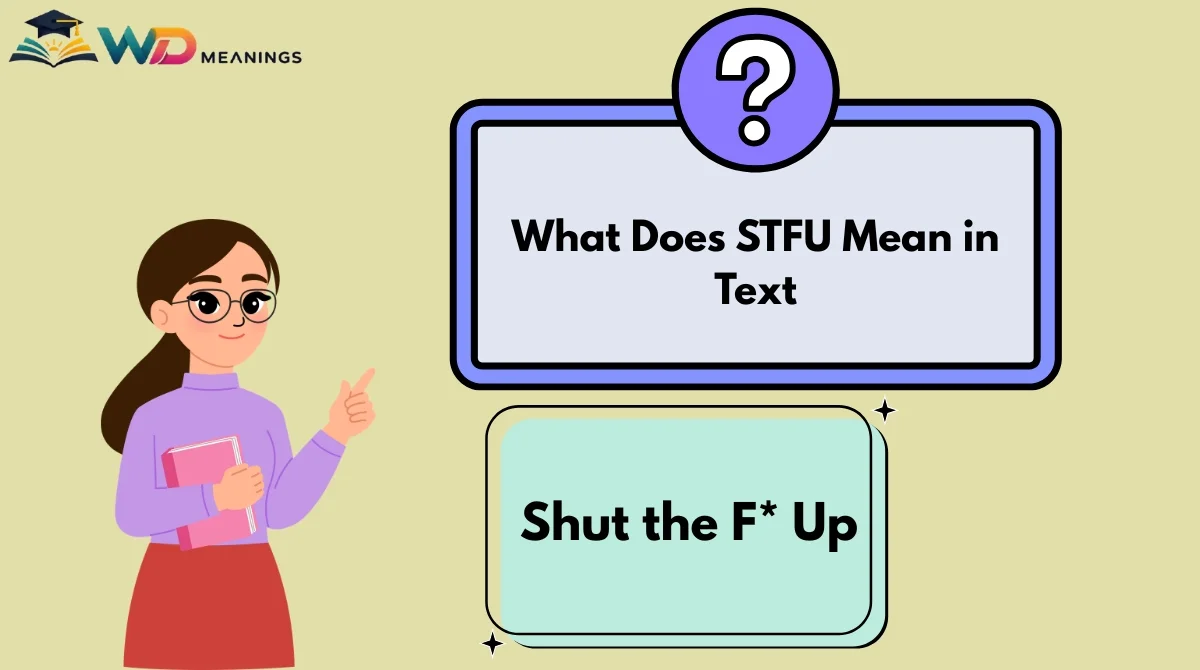
The short answer is that STFU usually stands for “Shut the F* Up.”** It’s a blunt expression telling someone to stop talking.
Depending on the relationship, tone, and conversation, it can be playful between close friends or highly offensive when used during an argument.
This guide explains what STFU means in text, where it came from, how people use it across different platforms, when it’s considered rude, and how you should respond in different situations.
Quick Answer
STFU means “Shut the F* Up.”** In text messages, chats, and social media, it’s commonly used to tell someone to stop talking. While it can be joking or playful among close friends, it is generally considered rude, aggressive, and offensive, especially when directed at someone during a disagreement.
What Does STFU Mean in Text?
The most common meaning of STFU in texting is:
STFU = Shut the F* Up**
Simple definition
It’s an internet abbreviation used to tell someone to be quiet or stop talking. Because it contains a swear word, it is much stronger than simply saying “be quiet.”
Pronunciation
People usually say the letters individually:
S-T-F-U
Occasionally, someone may say the full phrase aloud instead.
Tone and emotional meaning
The meaning depends heavily on context.
It may sound:
- Angry
- Frustrated
- Sarcastic
- Shocked
- Playfully dramatic
- Teasing among close friends
However, unless you know the sender well, STFU should usually be interpreted as rude or confrontational.
Text example
Alex: I just won two concert tickets!
Jordan: STFU! Seriously?!
In this example, STFU doesn’t mean “be quiet.” Instead, it expresses surprise similar to saying:
“No way!”
Context completely changes the emotional meaning.
Origin and Background
The phrase “Shut the f* up”** has existed in spoken English for many years as a stronger version of “shut up.”
As texting, online forums, and instant messaging became more popular, people shortened common phrases into abbreviations. STFU naturally became the online shorthand for the expression.
Today, it’s widely recognised across messaging apps, gaming communities, memes, and social media. Although its exact first online appearance isn’t clear, it became common as internet slang spread through chat rooms, forums, and later social platforms.
How STFU Is Used in Text Conversations
The same abbreviation can carry very different meanings depending on the conversation.
Friendly joking
Close friends sometimes use STFU after hearing surprising news.
Emma: I met my favourite actor yesterday.
Noah: STFU 😂 That’s amazing!
Here, it means:
“You’re kidding!”
During an argument
Someone may use STFU to end a disagreement.
Person A: You’re not listening.
Person B: STFU already.
Here, it’s clearly hostile.
Humorous exaggeration
Friends often use it dramatically.
Chris: I ate an entire pizza by myself.
Mia: STFU 😂😂
The sender is expressing disbelief rather than anger.
Reacting to unbelievable news
Someone may use STFU when hearing exciting information.
Liam: I got accepted into medical school.
Olivia: STFU!! Congratulations!!
Again, this isn’t intended as an insult.
Online gaming
Competitive games can become emotional.
A player might type:
STFU and focus.
In this situation, it’s usually impatient and rude.
What STFU Means on Different Platforms
Although the wording stays the same, the tone depends on the platform and the people involved.
On WhatsApp, STFU is commonly used between friends during casual conversations. Without emojis or other clues, however, it can sound harsh.
Snapchat
Snapchat conversations often include playful reactions.
For example:
STFU 😂
This usually means:
“I can’t believe that happened!”
You’ll see STFU in comments, direct messages, and replies.
People often use it to react dramatically to exciting stories, funny videos, or surprising announcements.
TikTok
TikTok users frequently comment:
- STFU 😂
- STFU that’s hilarious
- STFU I’m crying
These comments typically express amusement or disbelief rather than hostility.
On Facebook, STFU may appear in comment sections during debates, making it more likely to be interpreted as rude.
Discord
Discord servers—especially gaming communities—often use STFU casually among friends. In competitive discussions, however, it may become insulting.
Dating Apps
On dating apps, context matters even more.
If someone writes:
STFU 😂 you’re actually adorable
they’re probably flirting playfully.
But sending simply:
STFU.
without context may come across as disrespectful and could quickly end the conversation.
What Does STFU Mean From a Girl or Guy?
The abbreviation itself doesn’t change meaning based on gender.
Whether it comes from a girl, a guy, or anyone else, it still stands for “Shut the F* Up.”**
Instead, pay attention to factors like:
- Your relationship
- Previous conversations
- Emojis
- Capitalisation
- Punctuation
- Overall mood
For example:
STFU 😂
usually sounds playful.
Whereas:
STFU.
often sounds serious or annoyed.
Likewise,
STFU!!!!
can express excitement or intense frustration depending on the surrounding conversation.
Focus on context, not the sender’s gender.
Other Possible Meanings
Although “Shut the F* Up”** is overwhelmingly the most common meaning in texting, the abbreviation occasionally appears in specialised contexts.
| Meaning | Context | Example |
|---|---|---|
| Shut the F*** Up (most common) | Texting, social media, messaging | STFU 😂 that’s unbelievable! |
| Shut the F*** Up (literal command) | Arguments | STFU and leave me alone. |
| Internal joke or nickname | Private groups | Our group calls Friday meetings “STFU sessions.” (Only meaningful within that group.) |
For almost every text message or online conversation, you should assume STFU means “Shut the F* Up.”**
How to Respond to STFU
The best response depends on how it was intended.
If they were joking
Reply naturally.
Them: STFU 😂
You: I know! I couldn’t believe it either.
If they’re excited
Them: STFU!! You won?
You: Yep! I’m still shocked.
If you’re unsure
Clarify calmly.
You: Were you joking or serious?
If they sound angry
Avoid escalating.
You: I’d rather have a respectful conversation.
If it feels offensive
You can set a boundary.
You: Please don’t speak to me like that.
Funny response
Them: STFU 😂
You: Never. I have too much gossip.
Romantic response
Them: STFU 😍
You: I’ll take that as a compliment.
Serious situation
If someone repeatedly sends abusive or threatening messages—not just STFU but ongoing harassment—it may be best to stop engaging, block the sender if appropriate, or seek support if you feel unsafe.
Similar Texting Terms and Differences
| Term | Meaning | Key Difference |
|---|---|---|
| STFU | Shut the F*** Up | Much stronger and contains profanity. |
| STG | Swear to God | Used to emphasise honesty, not silence. |
| IDC | I Don’t Care | Shows indifference rather than telling someone to stop talking. |
| FR | For Real | Confirms something is genuine or asks if it’s true. |
| OMG | Oh My God | Expresses surprise without insulting anyone. |
Common Misunderstandings
One common mistake is assuming STFU is always an insult.
Among close friends, it often expresses:
- Surprise
- Excitement
- Disbelief
- Playful teasing
Another misunderstanding comes from punctuation.
Compare these:
STFU 😂
Usually playful.
STFU.
Often sounds annoyed.
STFU!!!
Could signal either excitement or anger depending on the rest of the conversation.
Capitalisation usually doesn’t change the meaning.
These versions are interpreted similarly:
- STFU
- stfu
- Stfu
Some people also mistake it for a harmless internet abbreviation because it’s only four letters. Remember that it still represents a phrase containing a swear word.
Is STFU Appropriate or Safe to Use?
In most situations, STFU is considered informal and offensive because it includes profanity.
It is generally not appropriate for:
- Work emails
- Professional chats
- School assignments
- Speaking with teachers
- Customer service
- Formal communication
It may be acceptable among close friends who regularly joke with one another and understand the intended tone.
If you’re unsure whether someone will appreciate the humour, it’s usually safer to avoid using STFU altogether. A less aggressive alternative such as “No way!”, “You’re kidding!”, or “Be quiet!” (used jokingly) is often a better choice.
Examples of STFU in Text
- STFU 😂 You actually met the singer?
- STFU!! I just checked—you were right.
- Please STFU for a second so I can explain.
- STFU, that’s the funniest thing I’ve heard today.
- He texted “STFU” after we started arguing.
- STFU 😂 I can’t stop laughing.
- She replied, “STFU 😭,” because she couldn’t believe the news.
- STFU… did you seriously win the holiday giveaway?
- The gamer kept typing STFU during the match.
- My best friend said STFU jokingly after I told her the surprise.
- I knew he was annoyed because his only reply was “STFU.”
- Everyone commented “STFU 😂” under the unbelievable video.
Frequently Asked Questions
Is STFU always rude?
No. While it literally contains profanity and is generally considered rude, close friends sometimes use it jokingly to express surprise or excitement. The surrounding conversation and your relationship with the sender are the biggest clues.
What does STFU mean from a friend?
From a friend, STFU may simply mean, “I can’t believe what you just said!” especially when paired with laughing or shocked emojis. Without those cues, it could still sound dismissive or irritated.
Can STFU be used in a positive way?
Yes, but only in certain informal situations. Someone might text “STFU 😂” after hearing unbelievable good news. In that case, they’re expressing amazement rather than telling you to be quiet.
Should I use STFU at work?
No. Because it includes a swear word, it’s not appropriate for professional communication. Even if intended as a joke, it can easily be misunderstood and appear disrespectful.
What’s the difference between STFU and “shut up”?
STFU is a much stronger version because it includes profanity. While “shut up” can sometimes be playful, STFU usually sounds more aggressive unless both people clearly understand it’s being used humorously.
What should I do if someone sends me STFU?
Look at the overall conversation. If it seems playful, respond in the same light-hearted way if you’re comfortable. If it feels hostile or disrespectful, it’s reasonable to ask for clarification, set boundaries, or end the conversation if necessary.
Conclusion
The answer to what STFU means in text is usually straightforward: it stands for “Shut the F* Up.”** Although the phrase literally tells someone to stop talking, its real meaning depends on context.
Between close friends, it can express shock, excitement, or playful disbelief. During arguments or formal conversations, however, it’s generally rude and offensive.
Before reacting, consider your relationship with the sender, the surrounding messages, emojis, and punctuation.
Understanding those clues will help you interpret STFU accurately and respond appropriately.

Hamz Ellis is a content writer at WD Meanings, specializing in internet slang, texting abbreviations, and digital communication. He creates clear, well-researched, and easy-to-understand content to help readers quickly find the meanings of modern online terms.