Understanding text abbreviations can be confusing, especially when the same letters have multiple meanings.
If you’ve recently received “DMD” in a message and wondered what it means, you’re not alone.
While many texting abbreviations have a single well-known definition, DMD is more context-dependent.
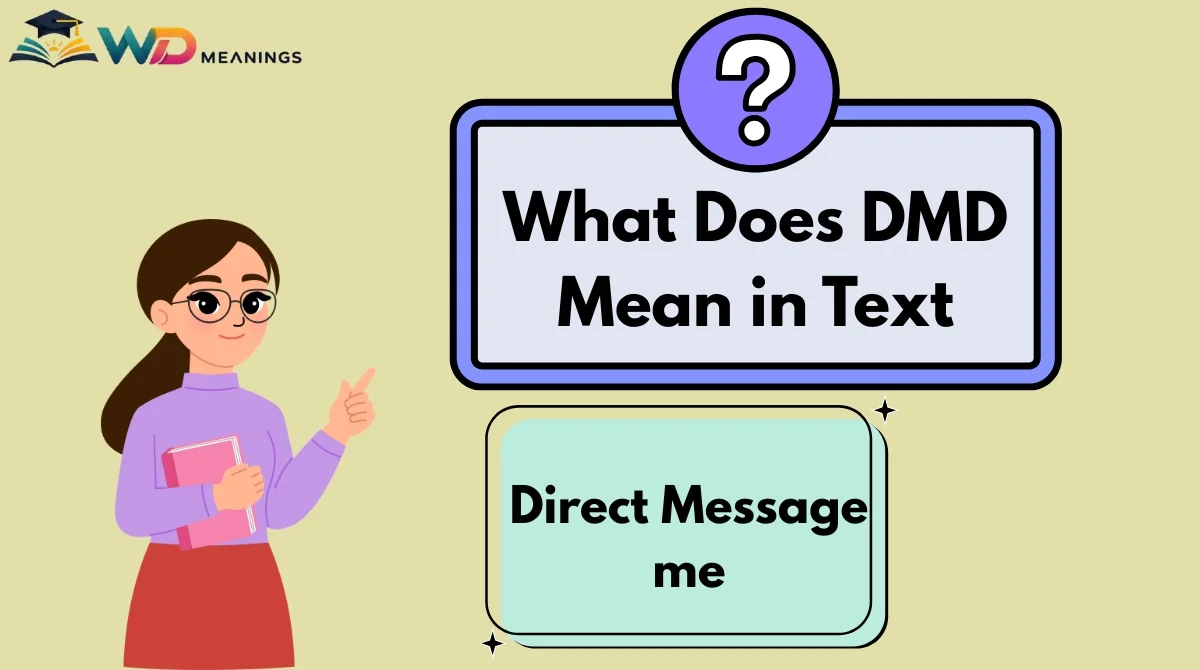
In most casual text conversations and social media chats, DMD commonly means “Direct Message me” or “Direct Message Delivered,” depending on the conversation and platform.
In some situations, people also use it as a shortened way of saying “DM’d,” meaning they have already sent someone a direct message.
Because the abbreviation isn’t as universally recognised as terms like “LOL” or “BRB,” understanding the surrounding conversation is the key to interpreting it correctly.
In this guide, you’ll learn what DMD means in text, where it’s used, how people use it on different social platforms, how to reply naturally, and the other meanings you might encounter.
Quick Answer
DMD most commonly means “Direct Message me” or refers to someone having “DM’d” (sent a direct message) in texting and social media conversations. Its exact meaning depends on context, but it almost always relates to private messaging rather than public comments. Looking at the surrounding conversation helps determine the intended meaning.
What Does DMD Mean in Text?
The meaning of DMD depends on how it’s used, but in everyday texting and online conversations, it usually relates to direct messaging.
Simple Definition
DMD generally refers to sending or requesting a direct message in a private chat instead of continuing a public conversation.
You’ll often see it when someone wants to move a conversation away from comments or group chats.
Full Form
Unlike many abbreviations, DMD doesn’t have one official universal full form. The most common interpretations include:
- Direct Message me
- DM’d (meaning “I sent you a direct message”)
- Occasionally, people simply type DMD instead of DMed or DM’d.
The intended meaning depends entirely on the sentence.
Pronunciation
Most people simply say the individual letters:
“Dee-Em-Dee.”
They rarely pronounce it as a single word.
Tone and Emotional Meaning
DMD itself is emotionally neutral.
Its tone changes depending on the conversation:
- Friendly
- Helpful
- Curious
- Flirty
- Professional
- Serious
The abbreviation doesn’t automatically imply any particular emotion.
Example
Alex: Can you send me the photos?
Taylor: DMD you a minute ago.
Meaning:
“I already sent you a direct message.”
Origin and Background
The popularity of DM (Direct Message) grew alongside social networking platforms that allowed users to communicate privately instead of posting publicly.
As online conversations became faster and more informal, users started shortening common phrases even further. Instead of writing:
- “I sent you a DM.”
- “I’ve DM’d you.”
- “Direct message me.”
Some people began typing DMD as an even shorter version.
Unlike established internet slang such as LOL or IMO, DMD isn’t governed by an official definition or standard spelling. Different users may type:
- DM’d
- DMed
- DMD
All may refer to the same idea of sending a private message.
Because texting language evolves naturally, slight spelling differences like these are common.
How DMD Is Used in Text Conversations
Most people use DMD when discussing private conversations rather than public replies.
Here are the most common situations.
1. Saying You’ve Already Sent a Private Message
This is probably the most frequent use.
Jamie: Did you send me the address?
Chris: Yep, DMD you.
Meaning:
“I’ve already sent you a direct message.”
2. Asking Someone to Contact You Privately
Sometimes DMD acts as a request.
Person A: I have a question.
Person B: DMD if you need help.
Meaning:
“Send me a direct message.”
3. Continuing a Private Conversation
People often move longer discussions into private chat.
Emma: I don’t want to post my phone number here.
Ryan: No problem, DMD me.
The conversation simply shifts from public to private.
4. Sharing Personal Information
Rather than posting addresses, emails, or account details publicly, users often request a direct message.
Example:
Customer: Can I get pricing?
Business: Sure! DMD us.
This keeps personal information private.
5. Friendly Conversations
Friends frequently use DMD when sharing photos, links, or inside jokes.
Ava: I found those holiday pictures!
Noah: Awesome! DMD them.
6. Romantic Conversations
Sometimes DMD appears when two people want a more personal conversation.
Jordan: I don’t want everyone reading this.
Taylor: DMD later ❤️
The abbreviation itself isn’t romantic—the relationship between the speakers creates the tone.
7. Humorous Uses
Friends occasionally joke with it.
Sam: I’ve got embarrassing photos.
Ben: Don’t post them… DMD instead 😂
What DMD Means on Different Platforms
Although every social media platform has its own features, DMD usually keeps the same general meaning: communicating through private messages.
On WhatsApp, people already chat privately, so DMD appears less often.
If someone says:
“DMD you.”
They usually mean:
“I’ve already sent you another private message.”
Snapchat
Snapchat revolves around private messaging, photos, and disappearing chats.
Someone might say:
“DMD me.”
They’re asking you to continue the conversation privately instead of replying elsewhere.
Instagram is probably one of the places where DMD appears most naturally.
Examples include:
- DMD you the details.
- DMD me your address.
- Check your DMs.
- I already DMD you.
Here it almost always refers to Instagram Direct Messages.
TikTok
Creators often encourage followers to contact them privately.
Examples:
- DMD for more information.
- DMD us for collaboration.
- DMD if you’re interested.
Again, the meaning stays the same.
Whether someone is commenting on a public post or interacting in a Facebook group, DMD usually signals moving the conversation into Messenger.
Example:
“I’ve DMD you the information.”
Discord
Discord mainly uses direct messages alongside servers.
Someone may write:
“DMD you.”
Meaning:
“I’ve sent you a private Discord message.”
Dating Apps
On dating platforms, DMD is less common because conversations are already private.
However, users sometimes mention it when discussing conversations that move to Instagram or another social network.
For example:
“DMD me on Instagram.”
Here, they’re asking to continue chatting on another platform.
What Does DMD Mean From a Girl or Guy?
Many people wonder whether DMD means something different depending on who sends it. In most cases, the answer is no. The abbreviation itself has the same meaning regardless of gender. What changes is the context, relationship, and tone of the conversation.
For example, if a friend texts:
“DMD you the photos!”
They’re simply letting you know they’ve sent a private message.
If someone you’re interested in says:
“DMD me later 😊”
The message may feel more personal because of your relationship, not because the abbreviation has a hidden romantic meaning.
Here are a few examples:
Between Friends
Liam: Did you get the concert tickets?
Emma: Yep, DMD you!
The tone is casual and friendly.
Between Classmates
Olivia: Can you send today’s notes?
Noah: Sure, DMD.
This is simply helpful and practical.
Between Two People Dating
Alex: I don’t want to talk about this here.
Jordan: DMD me when you’re free ❤️
The romantic feeling comes from the conversation and emoji—not from “DMD” itself.
Professional Conversation
Client: Could you send the invoice?
Freelancer: Certainly. DMD it just now.
Here, DMD remains polite and business-like.
Context Matters More Than Gender
When interpreting DMD, pay attention to:
- The relationship between the people chatting
- Emojis used alongside it
- Previous messages
- Whether the conversation is public or private
- The overall tone of the discussion
Those clues tell you far more than the sender’s gender.
Other Possible Meanings
Although “Direct Message me” or “DM’d” is the most common texting meaning, DMD can represent other things in different industries and professions.
| Meaning | Context | Example |
|---|---|---|
| Direct Message me / DM’d | Texting, social media | “I DMD you the details.” |
| Doctor of Dental Medicine | Healthcare | “She recently earned her DMD.” |
| Digital Micromirror Device | Technology and electronics | “The projector uses a DMD chip.” |
| Data Management Device | Technical documentation | “The DMD stores system data.” |
For everyday texting, the direct messaging meaning is by far the most common. If you’re chatting on social media, it’s almost certainly referring to private messages rather than dentistry or technology.
How to Respond to DMD
Your reply depends on what the sender means and the situation.
If Someone Says They Already DMD You
Them: DMD you.
You could reply:
- Thanks, I’ll check now.
- Got it!
- Just saw it.
- I’ll reply in a minute.
If They’re Asking You to DMD Them
Them: DMD me.
Possible responses:
- Sure!
- Sending one now.
- Just did.
- Check your inbox.
Friendly Reply
Friend: DMD you the photos.
You: Awesome, thanks!
Funny Reply
Friend: DMD me.
You: Only if there aren’t spoilers. 😂
Romantic Reply
Them: DMD me later ❤️
You: Definitely. Looking forward to it.
Confused Reply
If you’re unsure what they mean, it’s perfectly fine to ask.
You could say:
- Do you mean you sent me a direct message?
- Which app did you message me on?
- I don’t think I received it yet.
Serious Conversation
Them: DMD me about something important.
You: Sure. I’ll check right away.
Similar Texting Terms and Differences
Several abbreviations are closely related to DMD. While they all involve messaging, they aren’t interchangeable.
| Term | Meaning | Key Difference |
|---|---|---|
| DM | Direct Message | Refers to the private message itself. |
| PM | Private Message | Common on forums and some older platforms. |
| IM | Instant Message | Focuses on real-time chatting. |
| MSG | Message | A general abbreviation for any message. |
| DM me | Send me a direct message | A full phrase rather than an abbreviation like DMD. |
Although these terms are similar, DMD specifically refers to sending or requesting a direct message, whereas the others may describe different types of messaging.
Common Misunderstandings
Because DMD isn’t a universally standard abbreviation, misunderstandings can happen.
Confusing DMD With DM
Many people accidentally assume DMD and DM are identical.
While they’re closely related:
- DM usually refers to the private message itself.
- DMD often implies that someone sent one or wants someone to send one.
Reading It as a Medical Degree
Outside social media, DMD often stands for Doctor of Dental Medicine.
If someone says:
“My sister is a DMD.”
They’re talking about a dentist—not texting.
Assuming It Has a Hidden Meaning
Some readers believe DMD secretly signals flirting or romance.
It doesn’t.
Whether it’s friendly, romantic, or professional depends entirely on the surrounding conversation.
Capitalisation Doesn’t Usually Matter
You’ll see variations like:
- DMD
- dmd
- Dm’d
- DM’d
- DMed
Most people understand them as referring to direct messaging.
Platform Assumptions
Someone saying:
“I DMD you.”
doesn’t always mean Instagram.
It could refer to:
- X (formerly Twitter)
- Facebook Messenger
- Discord
- TikTok
- Snapchat
- Another platform with direct messaging
If you’re unsure, simply ask which app they mean.
Is DMD Appropriate or Safe to Use?
For most situations, yes.
DMD is:
- Informal
- Friendly
- Widely understood among social media users
- Suitable for casual conversations
It isn’t considered offensive, rude, or inappropriate by itself.
However, there are a few things to remember:
Personal Information
People often use DMD when moving a conversation into private messages to exchange:
- Phone numbers
- Email addresses
- Home addresses
- Payment information
Always be cautious before sharing sensitive personal information, especially with someone you don’t know well.
Professional Settings
While DMD is acceptable in relaxed workplace chats, writing the full phrase “I’ll send you a direct message” is usually clearer in formal business communication.
No Inherently Negative Meaning
Unlike some internet abbreviations, DMD does not normally suggest bullying, threats, explicit content, or harmful behaviour. It’s simply shorthand related to private messaging.
Examples of DMD in Text
Here are some original examples showing how DMD appears in everyday conversations.
- “I DMD you the meeting link a few minutes ago.”
- “Can you DMD me your email address?”
- “Thanks! I’ll check the DMD after work.”
- “Instead of posting it here, DMD me.”
- “I already DMD the organiser about the event.”
- “No worries—I just DMD you the answer.”
- “DMD me whenever you’re free tonight.”
- “She said she DMD everyone the schedule.”
- “I didn’t see your DMD until this morning.”
- “Could you DMD the recipe instead of putting it in the comments?”
- “We solved everything after she DMD me.”
- “Check your inbox—I DMD you the photos.”
These examples show that the abbreviation is almost always connected to private messaging, regardless of the platform.
Frequently Asked Questions
Is DMD the same as DM?
Not exactly. DM stands for Direct Message, referring to the private message itself. DMD is often used to mean “DM’d” (someone has already sent a direct message) or “Direct Message me.” Since DMD isn’t an official internet abbreviation, its meaning depends on the sentence and context.
What does DMD mean on Instagram?
On Instagram, DMD almost always relates to Instagram Direct Messages. Someone might say, “I DMD you,” meaning they’ve already sent you a private message, or “DMD me,” asking you to continue the conversation through Instagram’s messaging feature.
Is DMD a common texting abbreviation?
DMD is less common than abbreviations like DM, LOL, BRB, or IDK. While many social media users understand it, not everyone uses it regularly. If you want to avoid confusion, writing “I sent you a DM” or “Direct message me” is often clearer.
Does DMD always mean Direct Message?
No. Although Direct Message me or DM’d is the most common meaning in texting and social media, DMD can also stand for Doctor of Dental Medicine in healthcare or Digital Micromirror Device in technology. The surrounding conversation usually makes the intended meaning obvious.
Is DMD appropriate for work messages?
It depends on your workplace. In casual chats with colleagues or on workplace messaging apps, DMD is generally fine. However, in formal emails or professional communication, it’s usually better to write “I’ll send you a direct message” to ensure everyone understands your meaning.
How can I tell what DMD means in a conversation?
The easiest way is to look at the context. Ask yourself:
- Are people talking about social media or private messaging?
- Is the conversation about healthcare or technology?
- Does the sentence make sense if DMD means “direct message”?
If you’re still unsure, don’t hesitate to ask the sender what they meant. A quick clarification is better than making the wrong assumption.
Conclusion
DMD is a flexible abbreviation that most commonly refers to sending or requesting a direct message in texting and on social media.
Depending on the wording, it can mean “Direct Message me” or indicate that someone has already DM’d you.
Although DMD has other meanings in fields like dentistry and technology, those are far less common in everyday chats.
Whenever you see DMD, focus on the conversation’s context, platform, and tone to understand its intended meaning.
If there’s any doubt, asking for clarification is the simplest and most reliable approach.

Hamz Ellis is a content writer at WD Meanings, specializing in internet slang, texting abbreviations, and digital communication. He creates clear, well-researched, and easy-to-understand content to help readers quickly find the meanings of modern online terms.