If you have seen “FOS” in a text message, chat, or social media comment, you may wonder what the person actually means.
Short forms and internet slang often change depending on the conversation, platform, and relationship between people.
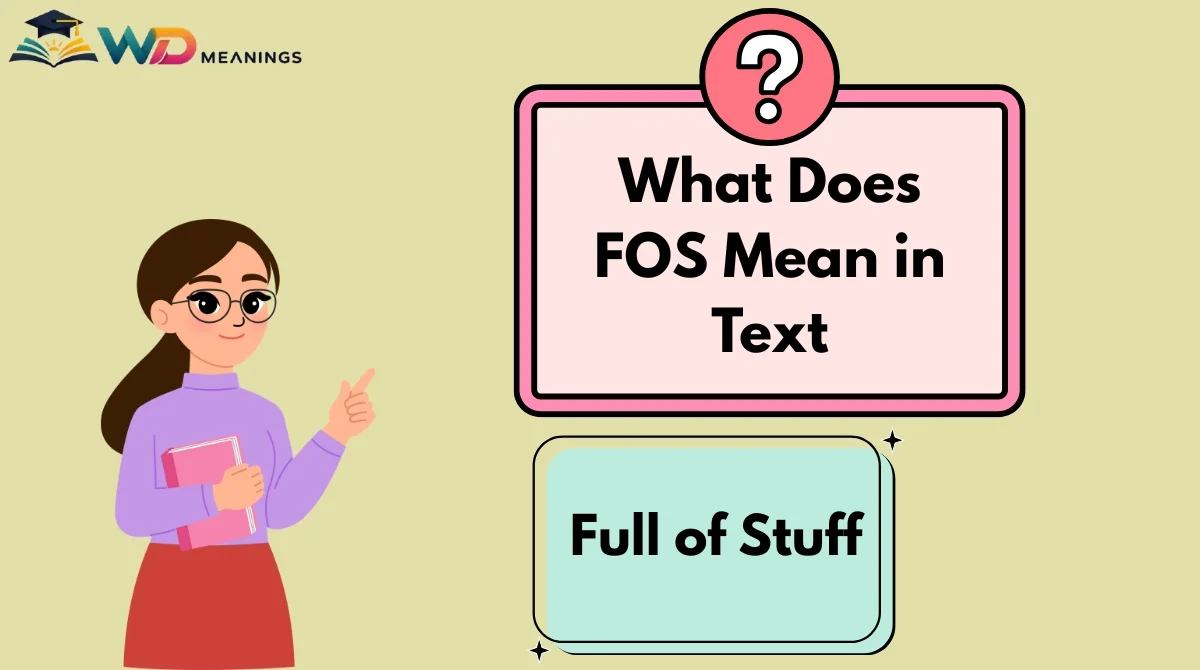
So, what does FOS mean in text? In most casual conversations, FOS usually means “Full of Stuff” or “Full of S*” (a slang expression meaning someone is not being truthful or is exaggerating)**, but the exact meaning depends heavily on context.
It can be playful between friends, sarcastic during an argument, or confusing when used by someone you do not know well.
This guide explains the common meanings of FOS, how people use it online, how to reply, and how to tell which meaning someone intends.
Quick Answer
FOS in text usually means “Full of S*,” a slang phrase used to say someone is exaggerating, joking, or not telling the truth.** It can be playful among friends or negative in serious conversations. Because FOS has multiple meanings, always check the surrounding message and tone.
What Does FOS Mean in Text?
The most common meaning of FOS in texting is “Full of S*.”** It is an abbreviation of a slang phrase used when someone believes another person is exaggerating, making something up, or being unrealistic.
The expression is usually informal and can have different emotional meanings:
- Playful: teasing a friend who tells a funny story
- Sarcastic: jokingly calling someone dramatic
- Negative: accusing someone of lying or being dishonest
Simple Definition
FOS means that someone is “full of nonsense,” “not being completely honest,” or “saying something exaggerated.”
Because the original phrase contains profanity, some people avoid writing the full version and use FOS instead.
How to Pronounce FOS
People usually pronounce FOS by saying the letters separately:
“F-O-S”
It is not commonly pronounced as one word.
Example in a Text Conversation
Friend 1: “I ran 20 miles before breakfast today.”
Friend 2: “FOS 😂”
Here, FOS is probably playful and means, “I don’t believe you” or “You’re exaggerating.”
Origin and Background
The exact origin of the abbreviation FOS in texting is difficult to confirm because many internet abbreviations develop naturally through informal communication rather than having one official creator or starting point.
The phrase behind FOS has existed in everyday slang for many years. As texting, online forums, gaming chats, and social media became popular, people began shortening common expressions to save time and space.
Like many abbreviations, FOS became useful because it allowed people to express an attitude quickly without typing the entire phrase.
It is worth noting that FOS can also stand for other phrases in different fields, so the meaning outside casual conversations may be completely different.
How FOS Is Used in Text Conversations
The meaning of FOS depends mostly on the relationship between the people chatting and the tone of the conversation.
1. Friendly Teasing
Among close friends, FOS is often used as a joke.
Example:
“I’m basically the best gamer in the world.”
“FOS 😂 but I respect the confidence.”
Here, the person is teasing, not seriously accusing the other person of lying.
2. Calling Out Exaggeration
Someone may use FOS when a statement sounds unrealistic.
Example:
“I finished my entire homework assignment in five minutes.”
“FOS, there’s no way.”
The sender means they doubt the claim.
3. Sarcastic Use
FOS can also appear when someone is being sarcastic.
Example:
“I totally love waking up at 5 AM every day.”
“Sure, FOS 😆”
The reply suggests the person does not believe them.
4. Negative or Serious Situations
In arguments, FOS can sound insulting.
Example:
“You said you never told anyone.”
“You’re FOS.”
Here, the sender is directly accusing the other person of dishonesty.
5. Humorous Internet Conversations
Online communities sometimes use FOS simply as a reaction.
Example:
“I can eat 50 burgers in one sitting.”
“FOS 💀”
The reaction means the statement sounds impossible.
What FOS Means on Different Platforms
The meaning of FOS generally stays the same across platforms, but the tone can change depending on the environment.
On WhatsApp, FOS is usually used between friends or people who already understand each other’s humor.
A laughing emoji, playful conversation, or casual topic often means it is a joke.
Example:
“I’m never going to buy more clothes.”
“FOS 😂”
Snapchat
Snapchat conversations are often casual, so FOS may appear as a quick reaction to a story or message.
Example:
Someone posts:
“I woke up looking perfect today.”
Reply:
“FOS lol”
It is likely playful teasing.
On Instagram comments or direct messages, FOS may be used when reacting to someone’s exaggerated post or caption.
Example:
Caption:
“The hardest workout ever.”
Comment:
“FOS 😂”
TikTok
TikTok users may use FOS as a joking response to dramatic videos, funny claims, or exaggerated captions.
The meaning depends strongly on whether the comment is friendly or critical.
Facebook conversations vary widely. Among friends, FOS may be humorous, but in debates or serious discussions it can sound disrespectful.
Discord
Gaming and community chats often use abbreviations casually. FOS may appear during jokes, competitive conversations, or friendly arguments.
Dating Apps
On dating apps, FOS should be interpreted carefully. A stranger using FOS may be joking, but it can also feel rude if the conversation is still new.
What Does FOS Mean From a Girl or Guy?
FOS does not have a different meaning based on whether it comes from a girl or a guy.
The important factors are:
- Your relationship with the person
- The topic being discussed
- Previous conversation style
- Emojis or punctuation
- Whether they are joking or arguing
Example: From Someone You Know
“I’m definitely the funniest person here.”
“FOS 😂”
A friend may simply be joking.
Example: From Someone You Are Dating
“I never check my phone during work.”
“FOS 🙄”
This could be playful flirting or a mild accusation depending on the relationship.
The same abbreviation can feel funny from a close friend but rude from someone you barely know.
Other Possible Meanings of FOS
FOS has several possible meanings outside casual texting. The context determines which one applies.
| Meaning | Context | Example |
|---|---|---|
| Full of S*** | Casual texting and slang | “You’re FOS if you think that happened.” |
| Full of Stuff | Cleaner informal version | “My bag is FOS with books.” |
| Fiber Optic System | Technology | “The company installed a new FOS network.” |
| Field of Study | Education | “What is your FOS at university?” |
| Family of Origin System | Psychology/social work | “The therapist discussed the client’s FOS.” |
In everyday texting, the slang meaning is usually the one people intend, especially in casual conversations.
How to Respond to FOS
Your reply depends on whether the person is joking, serious, or accusing you.
Funny Replies
- “Caught me 😂”
- “Okay, maybe I exaggerated a little.”
- “I prefer the term ‘creative storyteller.’”
- “You’ll never believe my amazing stories then.”
Friendly Replies
- “Haha, I’m just kidding.”
- “Okay, okay, you got me.”
- “Fair enough 😂”
Romantic or Flirty Replies
- “Only because I wanted to impress you 😉”
- “Maybe I’m exaggerating, but I’m still charming.”
When You Are Confused
- “Wait, what does FOS mean here?”
- “Are you joking or serious?”
When Someone Sounds Serious
- “I’m being honest, but I understand why you’d question it.”
- “Let me explain what happened.”
Similar Texting Terms and Differences
| Term | Meaning | Key Difference |
|---|---|---|
| LOL | Laughing out loud | Shows amusement, not disbelief |
| BS | Nonsense or dishonesty | Similar meaning but often more direct |
| JK | Just kidding | Shows something was a joke |
| TBH | To be honest | Introduces honesty or an opinion |
| OMG | Oh my God | Shows surprise or emotion |
FOS is mainly about doubting someone’s statement, while terms like LOL or OMG simply show reactions.
Common Misunderstandings
FOS can be confusing because abbreviations often have multiple meanings.
Confusing Slang With Other Definitions
Someone discussing technology or education may use FOS differently.
For example:
“The FOS program starts next month.”
This probably does not mean the slang phrase.
Capitalization Differences
Most people write it as:
- FOS
- fos
Capital letters are common because it is an abbreviation, but lowercase versions may appear in casual typing.
Missing Tone
Text messages do not always show emotion clearly.
Compare:
“FOS 😂”
with:
“FOS.”
The first sounds playful. The second may feel more serious or insulting.
Assuming It Is Always an Insult
Friends often use FOS as harmless teasing. Context matters more than the abbreviation itself.
Is FOS Appropriate or Safe to Use?
FOS is informal slang and is not usually suitable for professional communication.
Casual Situations
It may be acceptable when chatting with:
- Close friends
- Online gaming groups
- People who understand your humor
Workplace or Formal Situations
Avoid using FOS in:
- Emails
- Business chats
- School assignments
- Professional messages
Because it is connected to profanity, some people may find it offensive.
When Someone Uses FOS Negatively
If someone says FOS during an argument, they may be accusing someone of lying or exaggerating.
Pay attention to the situation before responding.
Examples of FOS in Text
- Friend: “I got 100% on every exam without studying.”
Reply: “FOS 😂” - Person A: “I never eat junk food.”
Person B: “FOS, I saw your burger post yesterday.” - Friend: “I’m totally ready for tomorrow’s presentation.”
Reply: “FOS, you were panicking five minutes ago.” - Comment: “This is the easiest challenge ever.”
Reply: “FOS 😭” - Friend: “I can finish this game in one hour.”
Reply: “FOS lol.” - Person A: “I don’t care about winning.”
Person B: “FOS, you were celebrating yesterday.” - Friend: “I’m going to save money this month.”
Reply: “FOS after that shopping trip.” - Person A: “I’m not tired at all.”
Reply: “FOS, you were sleeping five minutes ago.” - Friend: “I never make mistakes.”
Reply: “FOS 😂 nobody is perfect.” - Person A: “I cooked the best meal ever.”
Reply: “FOS until I taste it.” - Friend: “I’m quitting social media forever.”
Reply: “FOS, see you online tomorrow.” - Person A: “I’m completely calm before the interview.”
Reply: “FOS, your hands are shaking.”
Frequently Asked Questions
What does FOS stand for in texting?
In texting, FOS most commonly stands for “Full of S*,”** a slang phrase used when someone thinks another person is exaggerating or not telling the truth. However, it can have other meanings depending on the conversation.
Is FOS a bad word?
FOS is connected to a phrase containing profanity, so some people consider it inappropriate. Among friends it may be used jokingly, but it is better avoided in formal or professional situations.
Does FOS mean “fake”?
Not exactly. FOS can suggest that someone is being dishonest, exaggerating, or making unrealistic claims, but it does not literally mean “fake.”
Can FOS be used as a joke?
Yes. Many people use FOS playfully with friends. Emojis like 😂 or 😆 often show that the sender is teasing rather than seriously criticizing someone.
What should I say if someone texts FOS?
Your response depends on the tone. If they are joking, you can laugh along. If they sound serious, ask what they mean or explain your point.
Does FOS mean the same thing everywhere online?
Usually, yes, in casual texting. However, professional, educational, or technical conversations may use FOS with completely different meanings.
Conclusion
FOS in text most commonly means “Full of S*,” a slang expression used when someone thinks another person is exaggerating, joking, or not being truthful.**
The meaning depends on context, relationship, and tone. Between friends, it may be harmless teasing, while in serious conversations it can sound like an accusation.
Before reacting, check the surrounding messages, emojis, and situation.
Like many texting abbreviations, FOS is flexible, informal, and best understood by looking at how the person uses it.

Hamz Ellis is a content writer at WD Meanings, specializing in internet slang, texting abbreviations, and digital communication. He creates clear, well-researched, and easy-to-understand content to help readers quickly find the meanings of modern online terms.